Shorthand for the Chicago Neighborhoods Beyond the Loop
Few three-digit codes carry as much local weight as the one wrapped around most of Chicago. For residents and businesses alike, it is shorthand for the neighborhoods beyond the Loop — the bungalow blocks, the lakefront high-rises, and the commercial corridors that give the city its character. A phone number opening with this prefix tells a caller, instantly, that the person or company on the other end belongs to Chicago.
That local signal is exactly why the code remains in demand three decades after its debut. Whether a growing startup wants to look established in a competitive market or a national brand wants a genuine Chicago presence, the right number does quiet but real work. This guide explains where the code came from, the areas it covers, how dialing works today, and the practical steps to secure a line of your own.
Key Takeaways
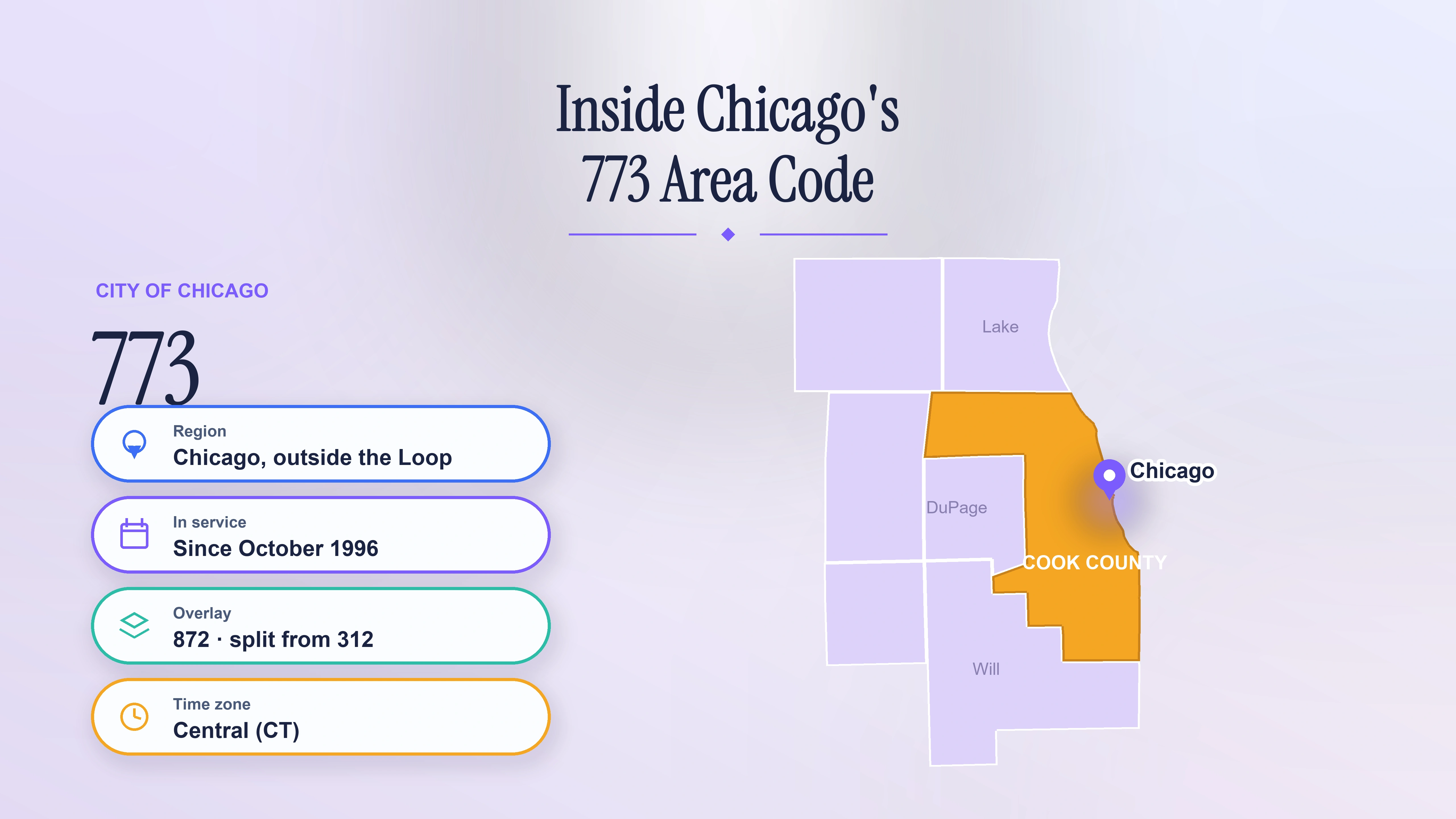
- The 773 prefix went live on October 12, 1996, when it was split from 312 to serve most of the City of Chicago outside the downtown Loop.
- It covers Chicago neighborhoods across the North, West, and South Sides — from Lincoln Park and Lakeview to Logan Square, Hyde Park, and Englewood — and sits in the Central Time Zone.
- Since November 2009 the region has shared the 872 overlay, so every local call now requires 10-digit dialing.
- A Chicago number signals local roots and credibility, which can lift answer rates and customer trust for area businesses.
- Cloud providers let a company activate a Chicago line in minutes, without a physical office in the city.
What Is the 773 Area Code?
Area code 773 is one of the telephone codes that serves the City of Chicago, Illinois. It entered service on October 12, 1996, created by splitting the original 312 code that had covered the entire city since 1947. As Chicago's population, business lines, pagers, and early mobile phones multiplied, the single code ran short of available numbers. Regulators kept 312 for the downtown core — roughly the Loop and the innermost neighborhoods bounded by North Avenue, Western Avenue, and 35th Street — and assigned the new prefix to everything else inside the city limits.
Permissive dialing let residents reach the old numbers under either code until January 11, 1997, after which the boundary became firm. The result is a code tied specifically to Chicago proper rather than its suburbs; nearby suburban communities fall under separate codes such as the 331 area code and its neighbors in the collar counties. That tight association with the city itself is a large part of why the number still reads as authentically local.
North, West and South Side Neighborhoods on the Map
Because the code was carved out of Chicago's original numbering plan, its footprint follows the city's own neighborhood map rather than municipal borders across the metro. Coverage stretches across all three sides of town, including:
- North Side: Lincoln Park, Lakeview, Uptown, Rogers Park, Albany Park, and Avondale
- West Side: Logan Square, Wicker Park, Humboldt Park, Austin, and Pilsen
- South Side: Hyde Park, Englewood, Bridgeport, Beverly, and South Shore
These neighborhoods hold a large share of Chicago's homes, small businesses, universities, and cultural institutions. A number rooted here reaches customers who live and work in the heart of the city, and it borders the suburban codes that ring Cook County and the surrounding collar counties.
Time Zone — Central Time
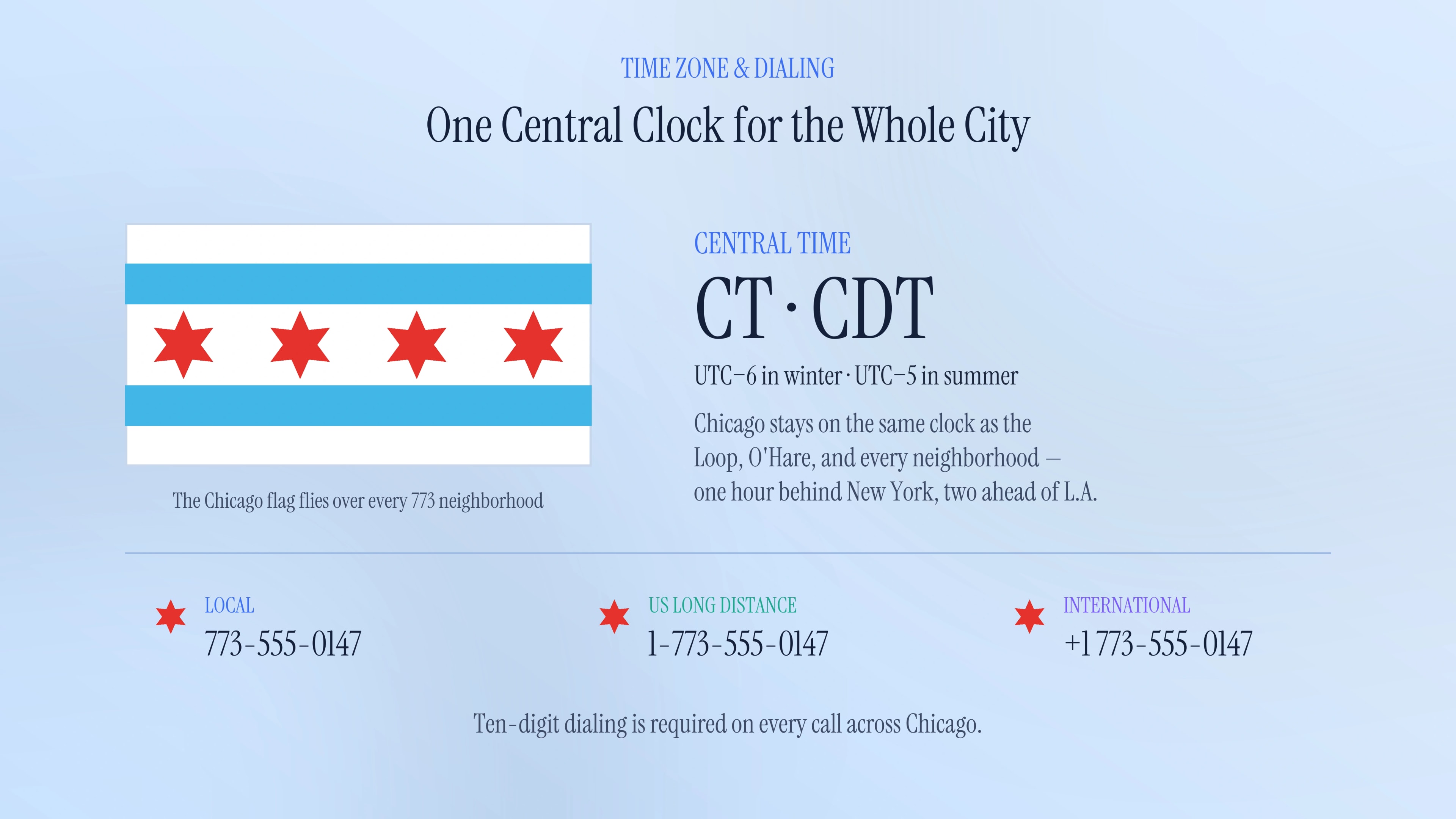
The entire region observes Central Time (UTC−6), shifting to Central Daylight Time (UTC−5) from spring through fall. For any business handling calls, that detail matters: Chicago runs one hour behind the East Coast and two hours ahead of the West Coast. Teams that schedule callbacks, staff support lines, or run outbound campaigns should map their hours to Central Time so a local number never rings a customer at an awkward moment. It is a small alignment that keeps a Chicago presence feeling genuinely local.
Dialing and the 872 Overlay
For its first years, callers within the code could dial just seven digits. That changed as Chicago again ran low on numbers. On August 10, 2007, the Illinois Commerce Commission announced an overlay: the 872 area code would be layered over the same territory served by both 312 and 773, adding a fresh pool of numbers without forcing anyone to change their existing line. The overlay took effect on November 7, 2009.
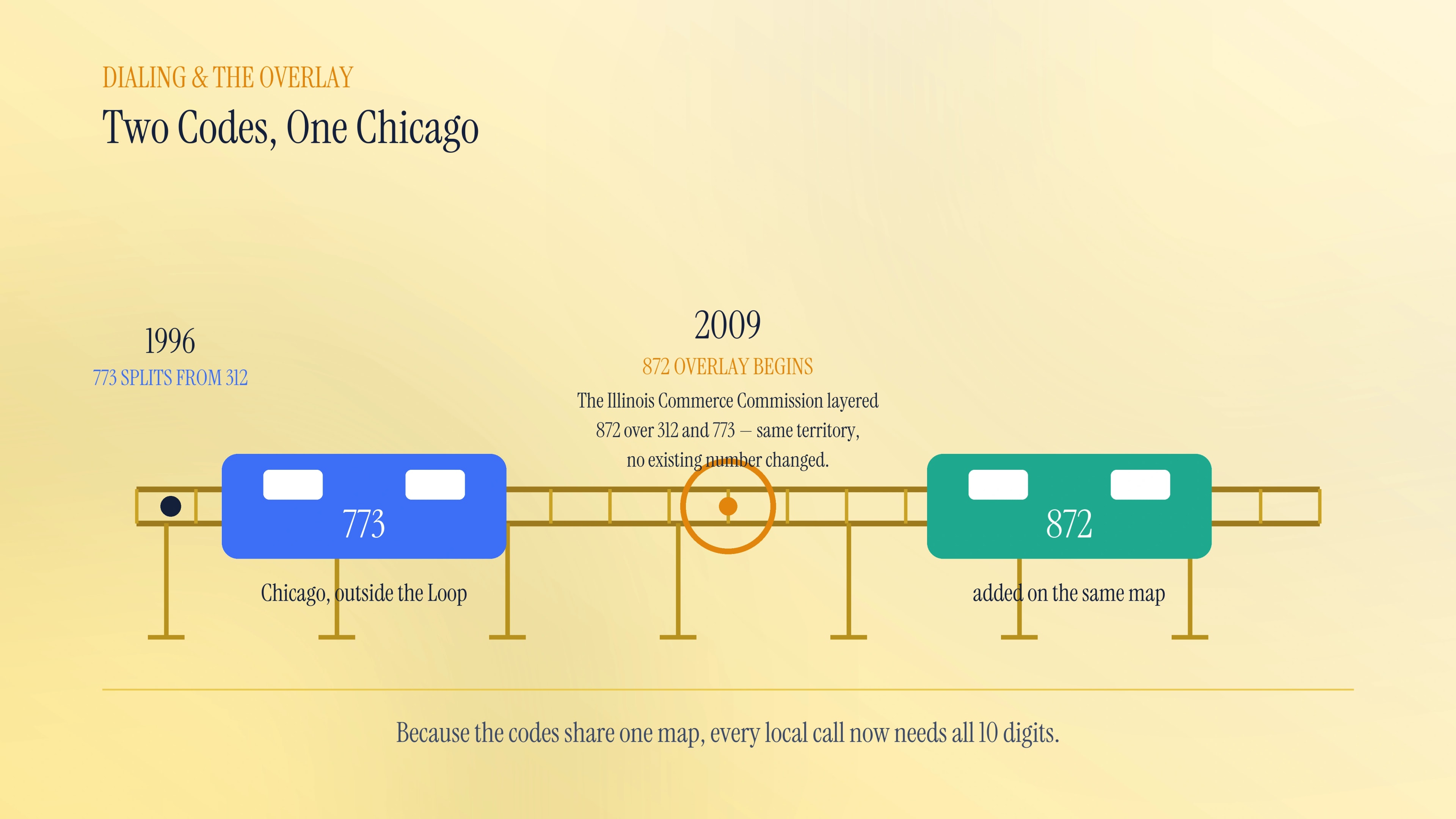
An overlay means several codes share one geographic area, so the phone network can no longer assume which code a local call belongs to. As a result, 10-digit dialing — the full area code plus the seven-digit number — is now mandatory for every call in Chicago, including calls between two numbers on the same block. For businesses, the practical takeaway is simple: always publish numbers in full 10-digit form so customers can dial them correctly the first time.
How a Chicago Number Benefits Your Business
A recognizable local code does more than mark a location; it shapes how customers respond before a call is ever answered. Key advantages include:
- Neighborhood-level trust: A 773 number signals roots in the North, West or South Side neighborhoods themselves — Logan Square to Hyde Park — rather than the downtown Loop that 312 already claims.
- Higher answer rates: Chicagoans are measurably more likely to pick up a call carrying their own 773 or 872 prefix than an out-of-state number.
- A foothold near universities and cultural anchors: The neighborhoods 773 covers hold a large share of the city's colleges, museums and cultural institutions, all of which expect a local contact.
- City-wide reach without a lease: Paired with a cloud phone system, one 773 number can route calls to a team anywhere while still sounding like it belongs on Chicago's streets.
Ready to claim your Chicago line?
Acepeak activates a Chicago number and connects it to a modern business phone platform — no hardware, no local office required. Set up routing, voicemail, and analytics in one place, and start taking calls the same day.
How to Get a 773 Number
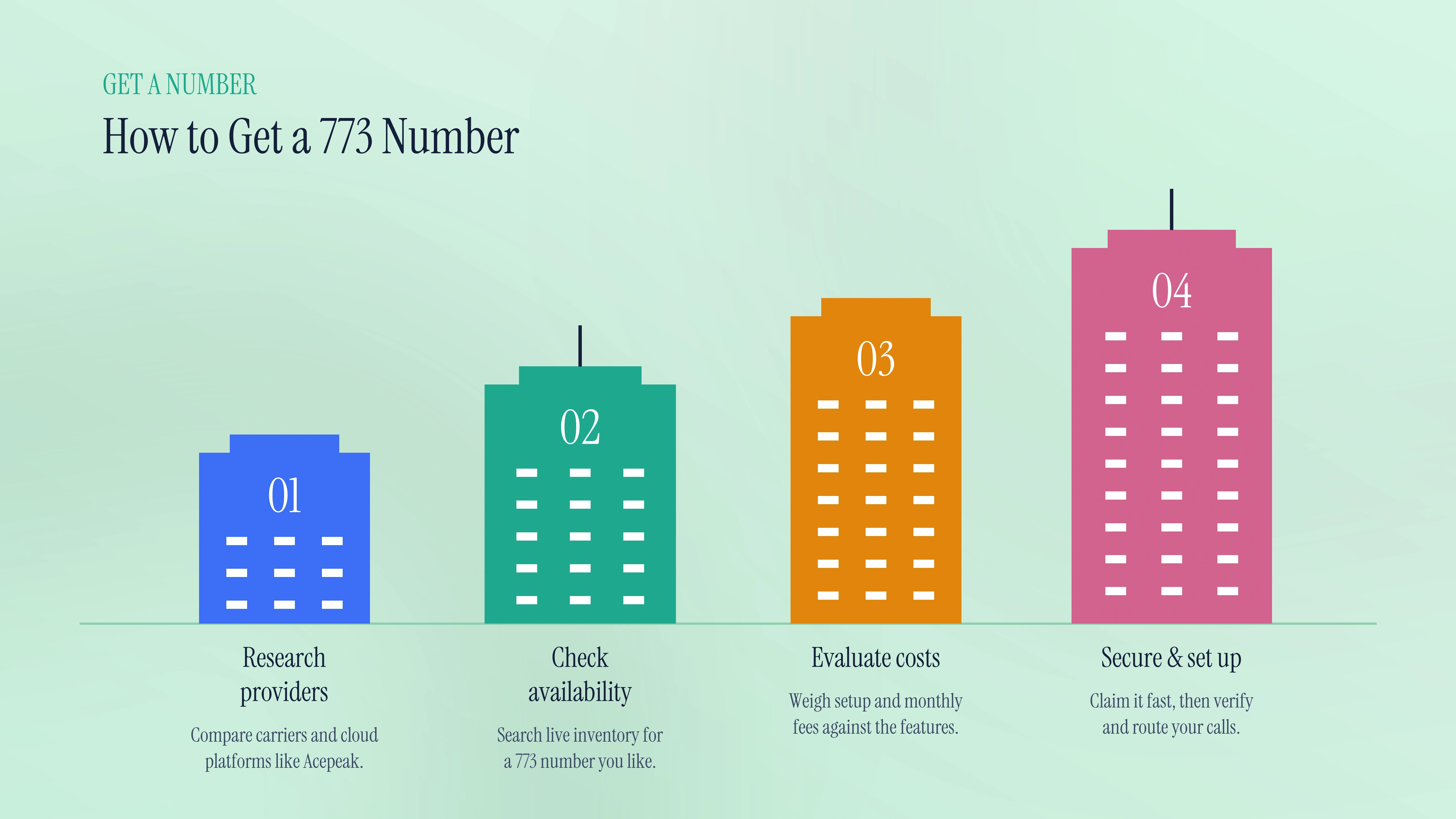
Getting a Chicago neighborhood number takes four steps, and working through them in sequence gives a business a better shot at digits that customers from Logan Square to Hyde Park will remember:
- Compare providers. Look for a carrier that lists 773 inventory specifically, since the 872 overlay now supplies many of the newest lines.
- Search current inventory. Filter for the exact neighborhood exchange you want, or ask about alerts when fresh 773 or 872 blocks open up.
- Weigh the features. Balance setup and monthly fees against routing, voicemail-to-email and analytics built for a multi-neighborhood business.
- Lock in the number. Chicago numbers move quickly, so complete verification and setup as soon as a good match appears.
Staying Aware of Scam Calls
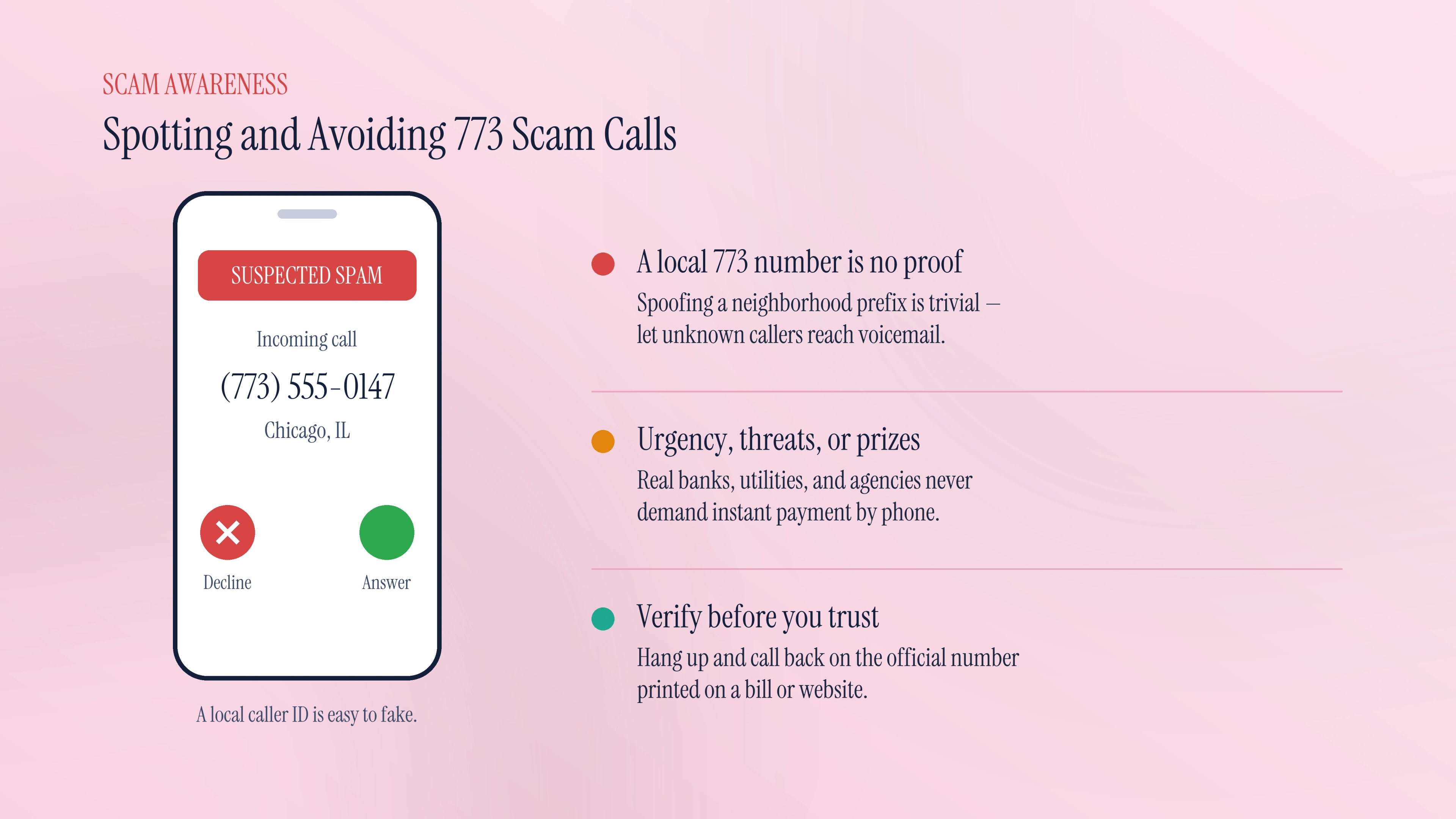
The same local familiarity that helps legitimate businesses can be abused by bad actors who spoof a Chicago code to appear trustworthy. A few habits help customers and teams stay protected:
- Be wary of urgency. Threats, prizes, or "act now" pressure are classic warning signs, regardless of the code on the screen.
- Never share sensitive data on inbound calls. Verify the caller through an official number before giving any account or payment details.
- Confirm the source independently. Look up a company's published contact line rather than trusting a number that called you.
- Report and block. Flag suspicious calls so carriers and regulators can track spoofing patterns.
The Future of the 773 Area Code
Chicago's numbering has proven remarkably durable. The 872 overlay added capacity for the whole city, and regulators expect that combined pool to serve the market for years before any further relief is needed. Meanwhile, the city itself keeps investing in its neighborhoods and business districts — the kind of long-term momentum the City of Chicago highlights across its economic and community initiatives.
Chicago businesses can plan around that durability. Relief has come through the shared 872 pool rather than another split like the one that created 773 in 1996, so a number chosen today is unlikely to be reassigned. Hosted on a cloud platform, the same line can follow a company from a Wicker Park storefront to a remote team or an office in another city and still read as a Chicago neighborhood number.
A Chicago Presence Without the Storefront Overhead
More than a set of digits, this prefix is a piece of Chicago's identity — mapped onto the neighborhoods where the city actually lives and works. It offers businesses instant local credibility, better answer rates, and a genuine presence in one of the country's largest markets, all without the overhead of a physical storefront. With modern cloud calling, claiming and running a Chicago line has never been easier. For any company serious about the Chicago market, a local number is a small step that pays off in trust.
Take the next step with Acepeak
Give your business an authentic Chicago presence today — Acepeak activates local 773 numbers fast and pairs them with a full-featured cloud phone system, routing, analytics, and support included.
Questions, answered.
It serves most of the City of Chicago, Illinois — the neighborhoods across the North, West, and South Sides that sit outside the downtown Loop, which uses 312.
It went into service on October 12, 1996, after being split from the original 312 code to relieve number shortages in Chicago.
The region follows Central Time (UTC−6), moving to Central Daylight Time (UTC−5) during daylight saving months.
Yes. Because the 872 overlay shares the same area, every local call in Chicago requires the full 10-digit number, even between nearby lines.
Yes. Cloud providers like Acepeak can activate a local Chicago line remotely and route it to a team anywhere, with no physical location required.
No. The 872 overlay expanded the available supply for the entire city, and the combined pool is expected to meet demand for the foreseeable future.
Signing up for a 773 area code number takes minutes with a cloud phone provider — no local office in Illinois required. Pick the number, connect it to your existing phone or app, and calls route in immediately. This keeps the 773 area code presence you already have while adding the local credibility Illinois customers respond to.