Introduction
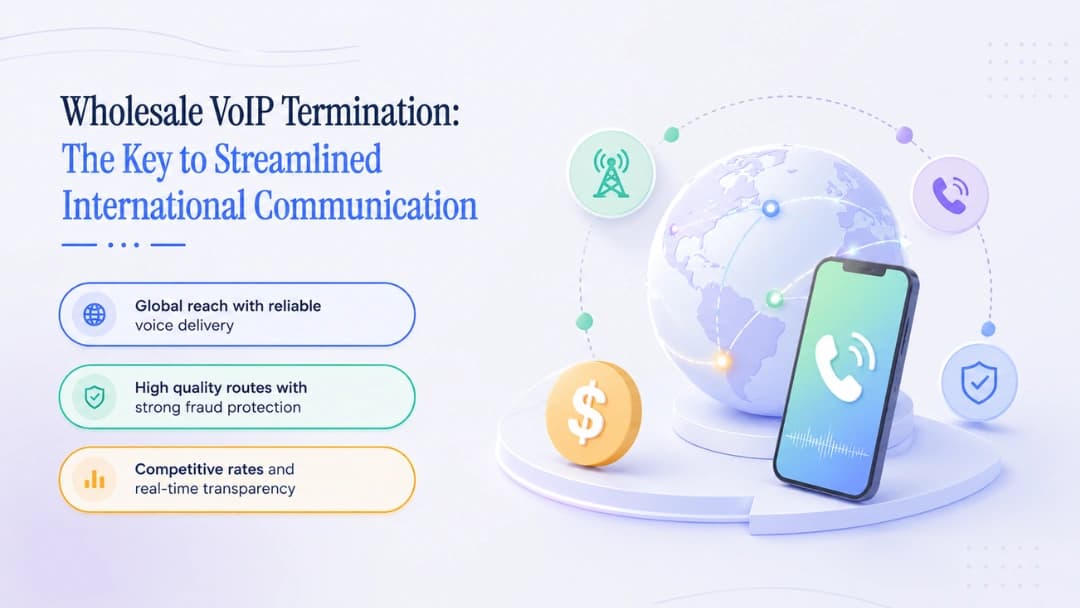
Most businesses never think about wholesale voice. They buy a phone plan, or a contact center seat, and calls just work. Behind that plan sits a carrier that bought minutes in bulk from another carrier, who bought them from another. Wholesale voice services are that bulk layer: capacity to send and receive calls, sold per minute to resellers, platforms and operators.
If you are about to buy, resell or switch, the decision is harder than a price list suggests. Two carriers can quote the same rate to the same country and deliver very different results. This guide covers what you are actually buying, how the billing arithmetic works, which numbers to ask for, and where buyers tend to get burned.
Key Takeaways
- Wholesale voice services are bulk call capacity sold per minute to resellers, platforms and carriers, at rates well below retail.
- The quoted rate is only the start. Billing increment and route quality change what you really pay.
- The cheapest rate usually has a reason behind it. Ask which route sits underneath before you sign.
- Never move volume on a promise. Run a test on your own destinations first.
- Ask for ASR, ACD and PDD by destination, not one blended number.
What Are Wholesale Voice Services?
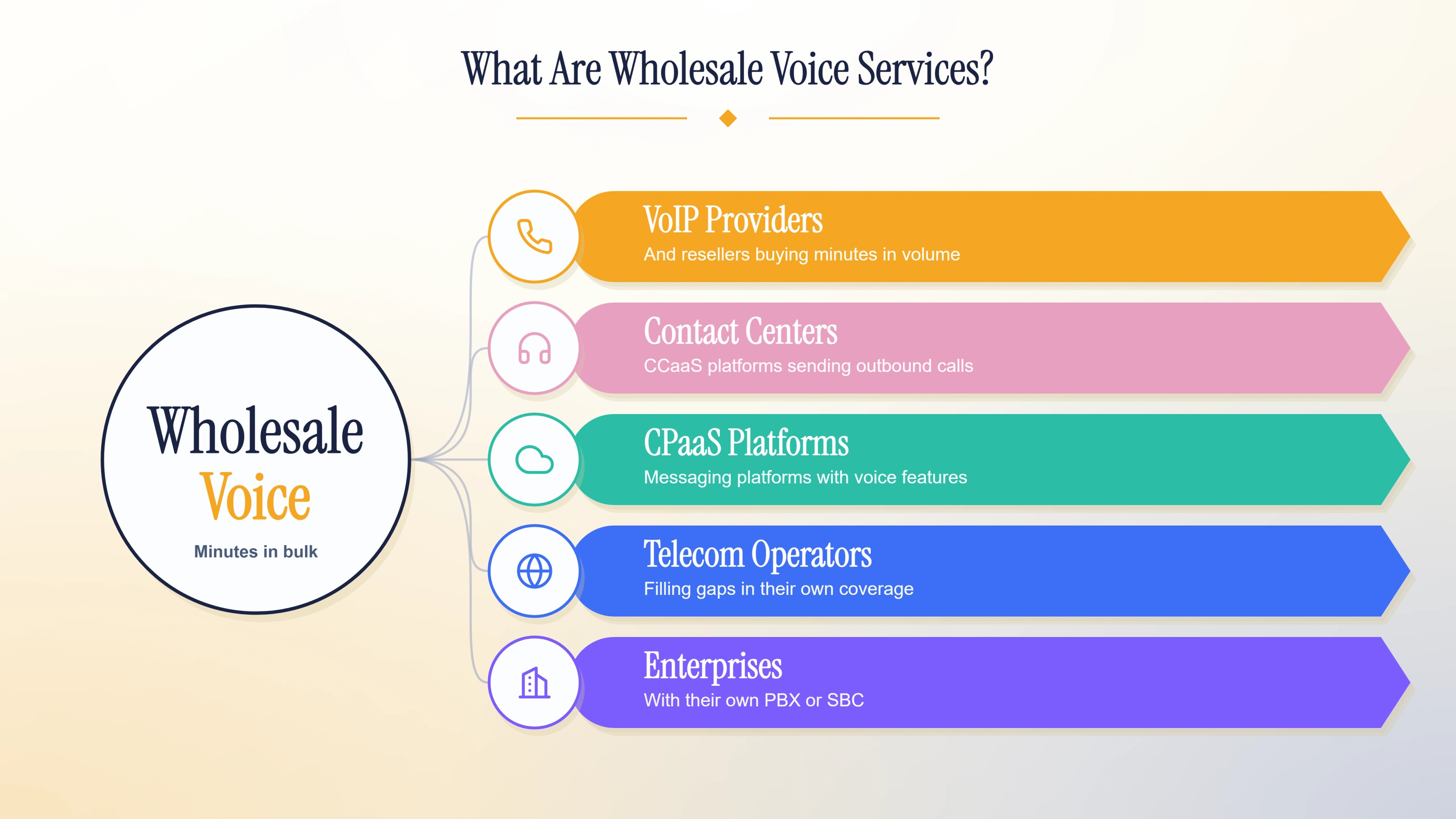
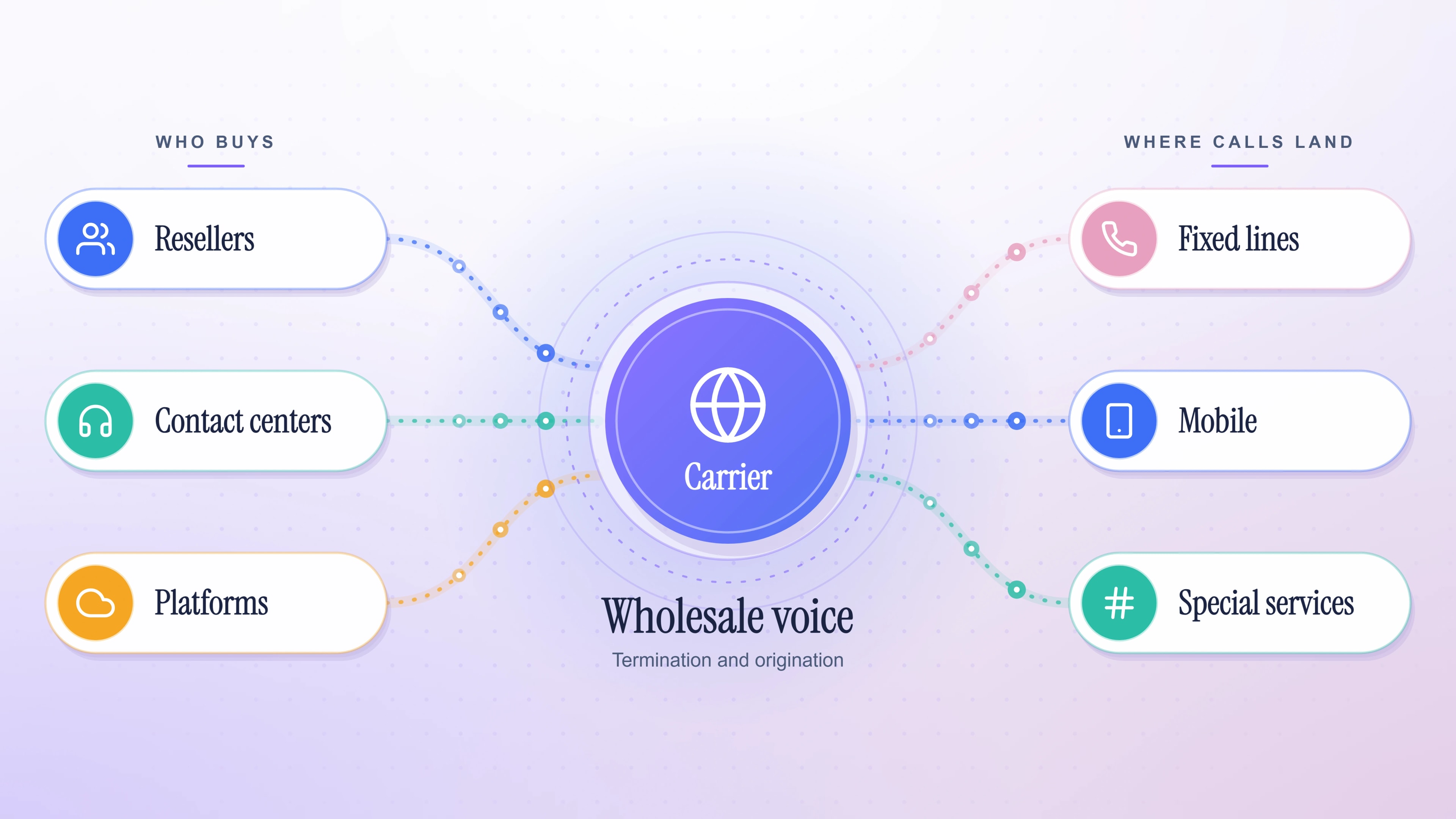
Retail voice is sold to the person making the calls. Wholesale voice is sold to whoever is going to sell it on, or build it into something else. A VoIP provider buys minutes to resell under its own brand. A contact center platform buys them to power outbound campaigns. A CPaaS company buys them so developers can add calling with an API.
The buyers usually fall into a handful of groups:
- VoIP providers and resellers who sell minutes on under their own brand.
- Contact center and CCaaS platforms that place large volumes of outbound calls.
- CPaaS and messaging platforms that offer voice as one feature among many.
- Telecom operators that need coverage in places their own network does not reach.
- Enterprises that run their own PBX or session border controller and want a direct carrier connection.
What they share is volume. Nobody here wants one phone line. They want dependable capacity to many destinations, at a cost per minute they can plan around.
How a Wholesale Call Reaches Its Destination
Wholesale voice services follow the same path for every call, so follow one from start to finish. Your platform sends it to your carrier over a SIP trunk. The carrier looks at the number dialed, picks a route, and passes the call to the network that serves that number. That network rings the person being called. If they pick up, billing starts.
The step that matters most is the one you never see: the route choice. A carrier often has several upstream paths to the same country. Some are direct connections to the local operator. Others pass through one or two other carriers first. Each extra hop adds delay and a chance for something to go wrong, such as dropped caller ID or poor audio.
That is why the same destination can behave well on Monday and badly on Thursday. Routes change underneath you. So measure each destination on its own, and do not trust a single average for the whole account.
The Main Wholesale Voice Services
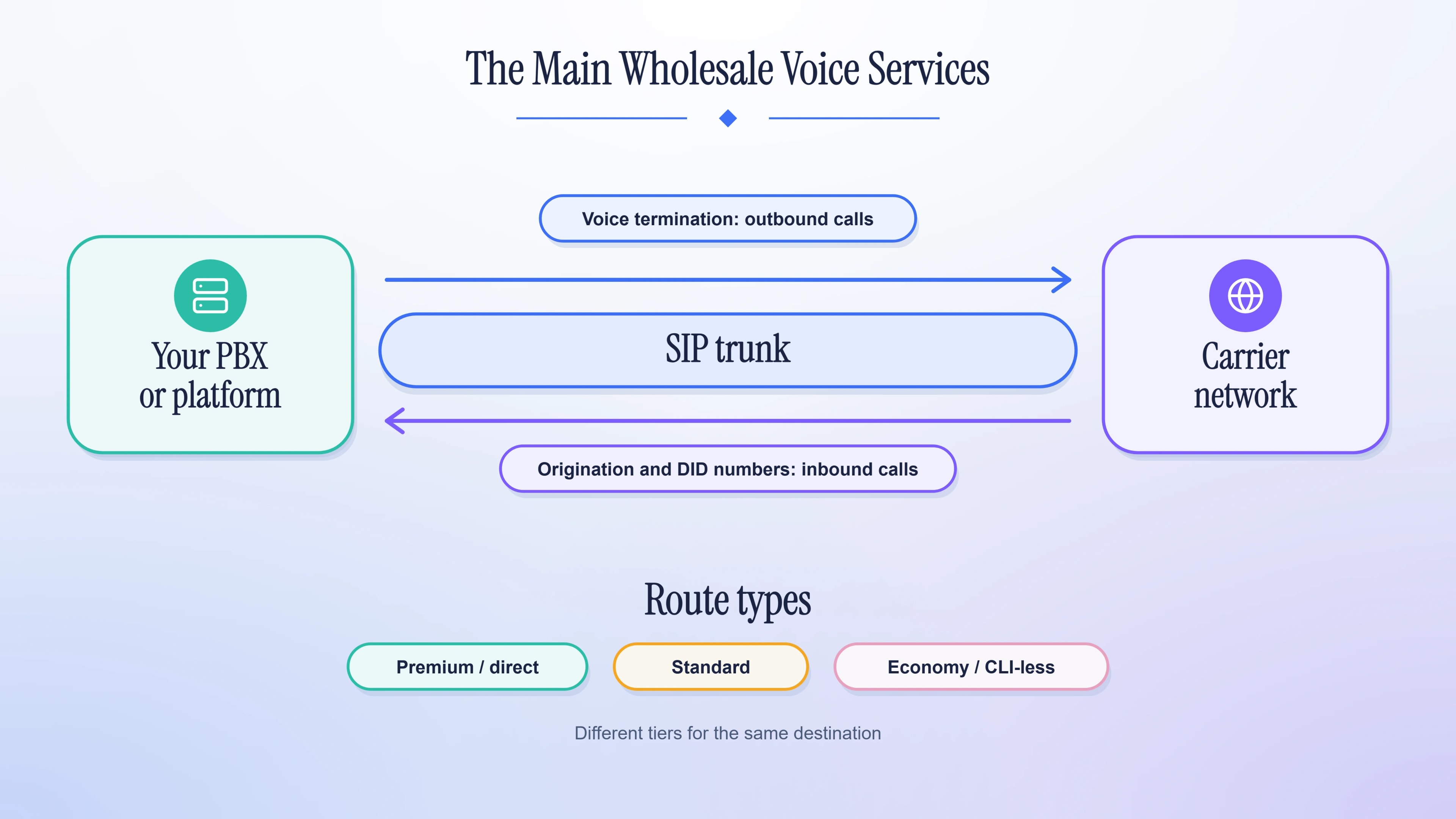
Voice termination
Termination is the outbound side. You hand the carrier a call and it delivers that call to the destination number. It is billed per minute, and the rate depends on the country and the type of number: a fixed line costs differently from a mobile, and special-service numbers are priced separately again.
Origination and DID numbers
Origination is the inbound side. Callers dial a local, national or toll-free number, and the carrier delivers the call to you. These numbers are called DIDs, and they are normally sold for a monthly fee plus per-minute charges. If inbound is your main need, start with wholesale DID numbers.
SIP trunking
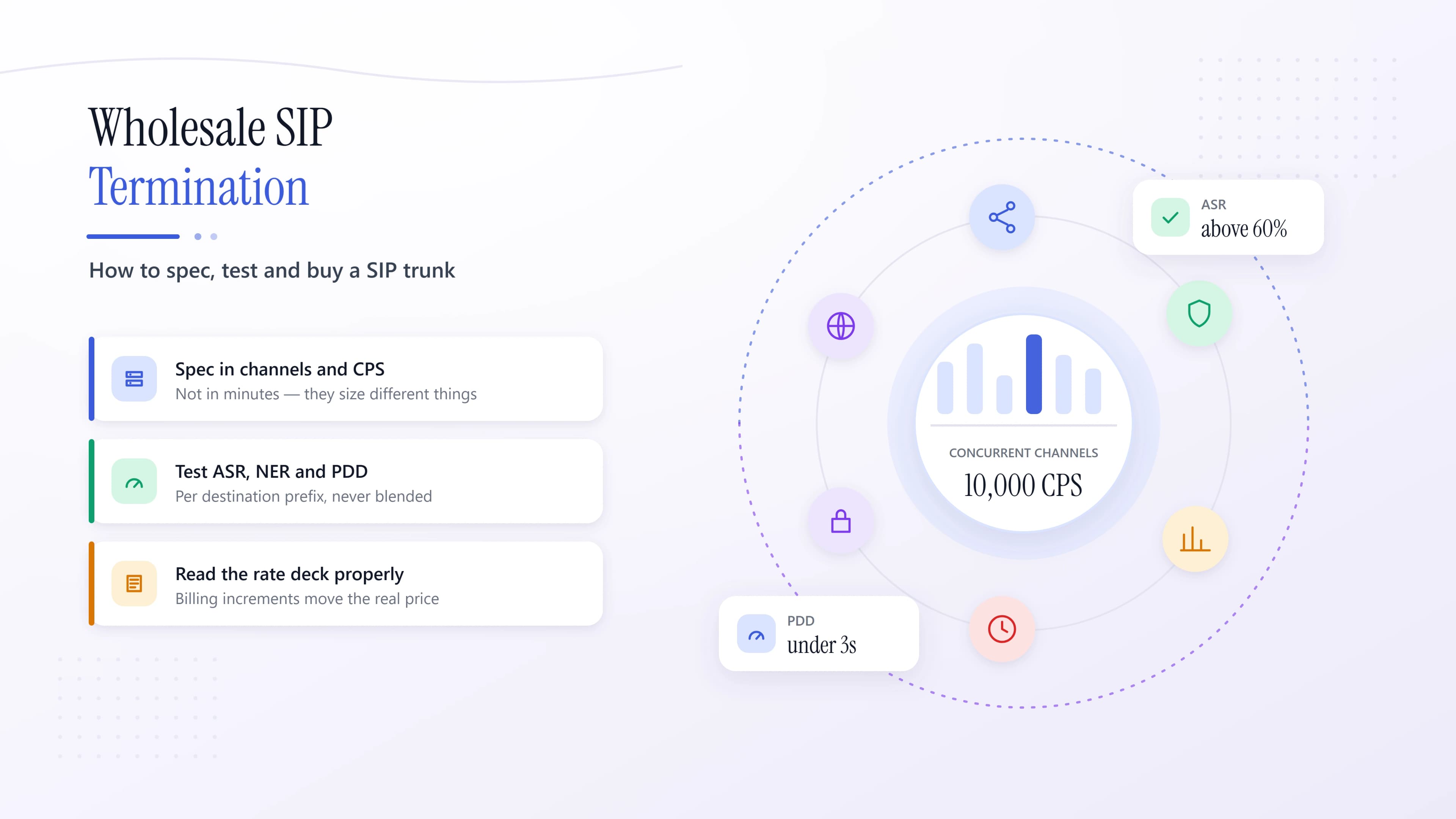
A SIP trunk is the connection that carries both directions of traffic between your system and the carrier, over IP. One trunk replaces a rack of old phone lines and handles many calls at once. Sizing it, testing it and writing the contract terms is covered in the wholesale SIP termination guide.
Route types
For the same destination, carriers usually sell more than one quality of route. The labels differ from one provider to the next, so ask what each one means in practice:
| Route tier | Typical use | What to ask |
|---|---|---|
| Premium / direct | Business and customer-facing calls | Is the route direct, and is caller ID delivered? |
| Standard | General traffic | What are the ASR and ACD on my destinations? |
| Economy / CLI-less | Cost-sensitive traffic | Does caller ID pass, and how much does quality vary? |
Economy routes are not automatically bad. They suit traffic where nobody checks who is calling. They are a poor fit for anything that depends on caller ID, such as verification calls, or calls to customers who will not answer an unknown number.
How Wholesale Voice Pricing Works
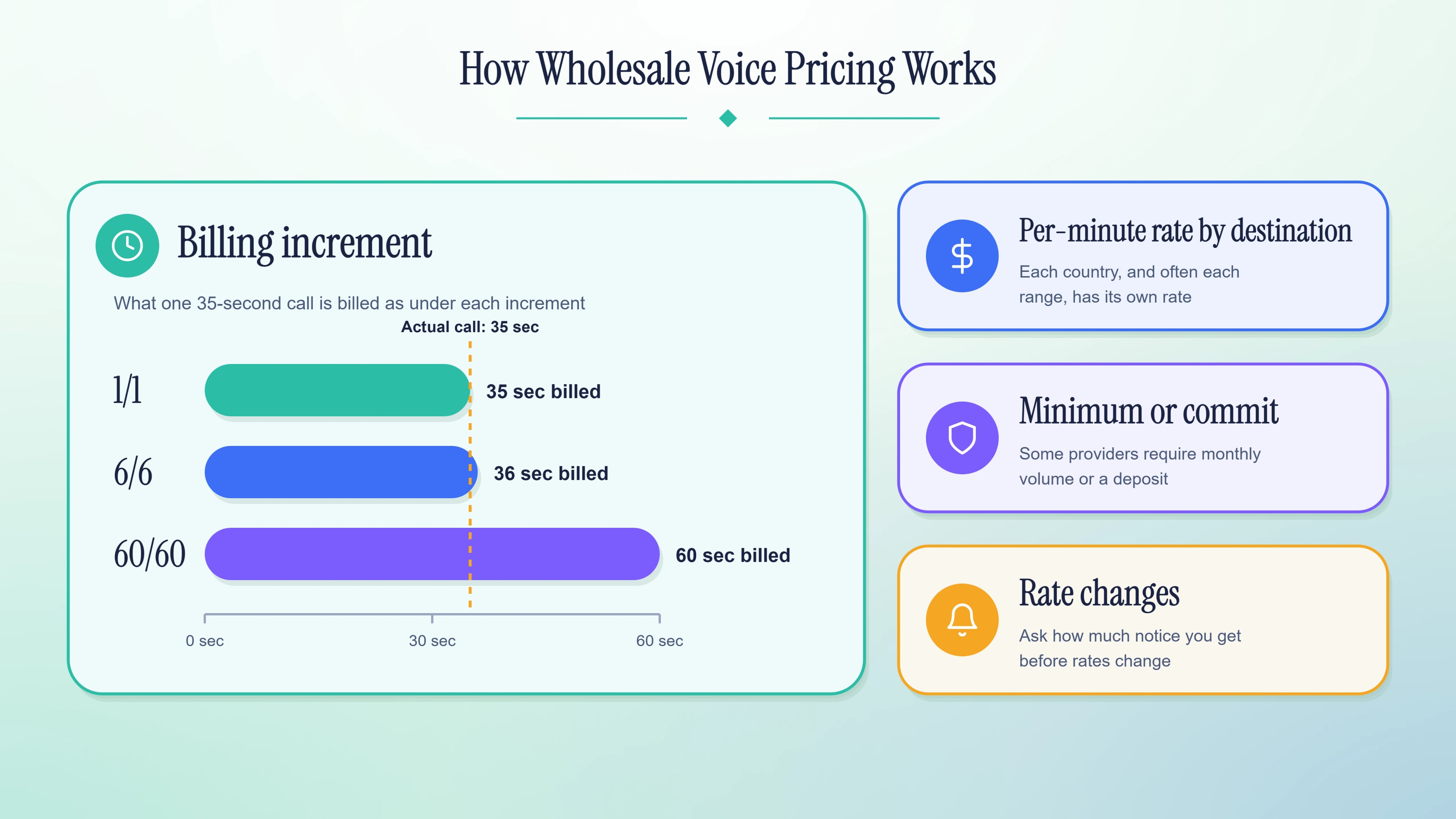
A rate deck for wholesale voice services looks simple: a list of destinations and a price per minute. Four things sit behind it.
- The rate itself. Each country has its own, and large markets are often split into fixed, mobile and individual operator ranges.
- The billing increment. This is how a call is rounded up. 1/1 bills to the second. 6/6 rounds up to the next six seconds. 60/60 rounds every call up to the next full minute.
- Minimums and commitments. Some carriers want a monthly spend, a deposit, or both.
- Notice of rate changes. Find out how many days you get before a new price applies.
The increment is the one people overlook. Take a 35-second call at a rate of $0.02 per minute. Billed 1/1, it costs about $0.0117. Billed 6/6, it is billed as 36 seconds and costs $0.012. Billed 60/60, it is billed as a full minute and costs $0.02. For short calls, that is roughly 70% more for the same traffic at the same listed rate. A contact center with many short calls can feel this more than a rate difference of a few percent.
So a quote cannot be judged by its headline number. Take a sample of your own call records, apply each rate deck and increment to it, and compare the totals. That comparison is the only fair one. If you want the detail on the billing side, the wholesale VoIP termination guide goes further.
The Quality Metrics That Matter
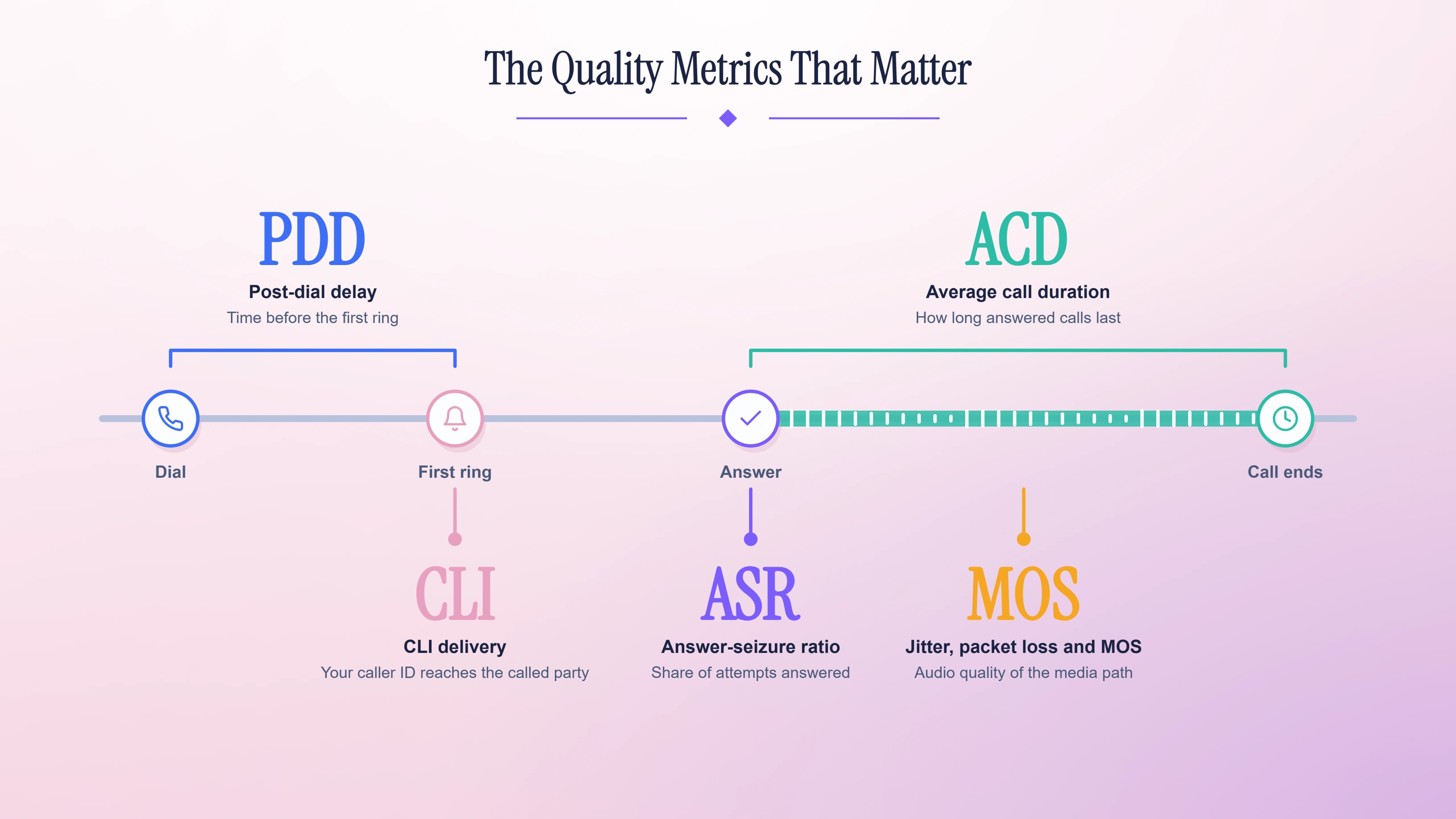
A low rate on a route that fails is not cheap, whichever of the wholesale voice services you buy. Failed calls are usually not billed, so the cost shows up elsewhere: retries, wasted dialer time, and customers who give up. Ask every carrier for these figures, broken down by destination.
- ASR (answer-seizure ratio). The share of call attempts that get answered. If a dialer places 100,000 attempts a day and ASR falls from 50% to 40%, that is 10,000 fewer conversations from the same effort.
- ACD (average call duration). How long answered calls last. A sudden fall in ACD often means the audio is bad and people are hanging up.
- PDD (post-dial delay). The wait between dialing and the first ring. Past a few seconds, callers assume something is broken.
- Jitter, packet loss and MOS. The audio quality measures for the media path.
- CLI delivery. Whether your caller ID actually arrives.
Ask for the same period across every carrier you compare, such as the last seven days. A blended average across all destinations hides the weak routes, and weak routes are where complaints come from.
Then check the numbers yourself. Send a small, controlled amount of live traffic and compare it with your current provider. The wholesale SIP termination guide includes a full test plan.
Want rates and route quality by destination?
Tell us your destinations and monthly volume and we will send a rate deck and set up a test.
How to Choose a Wholesale Voice Provider
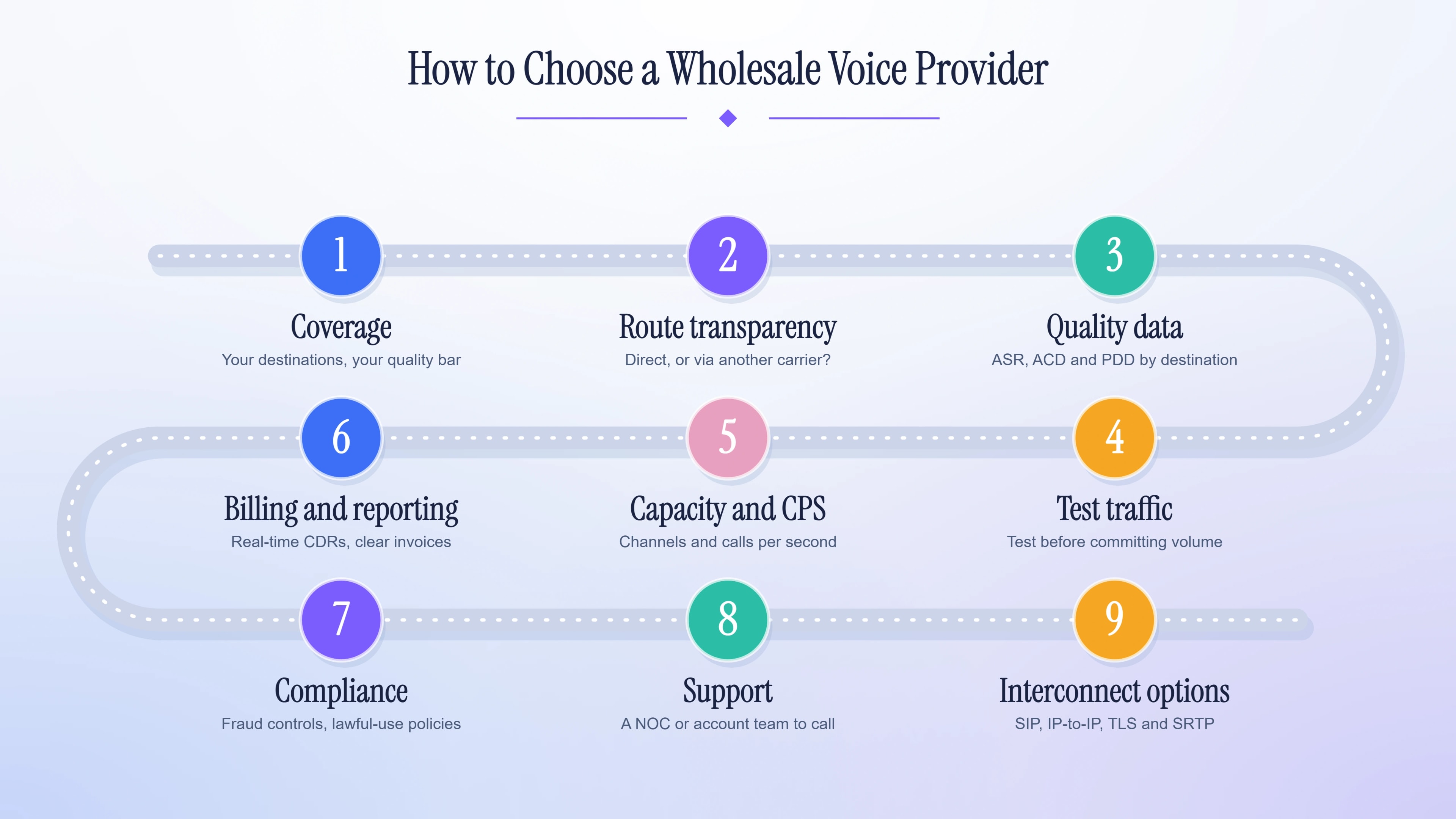
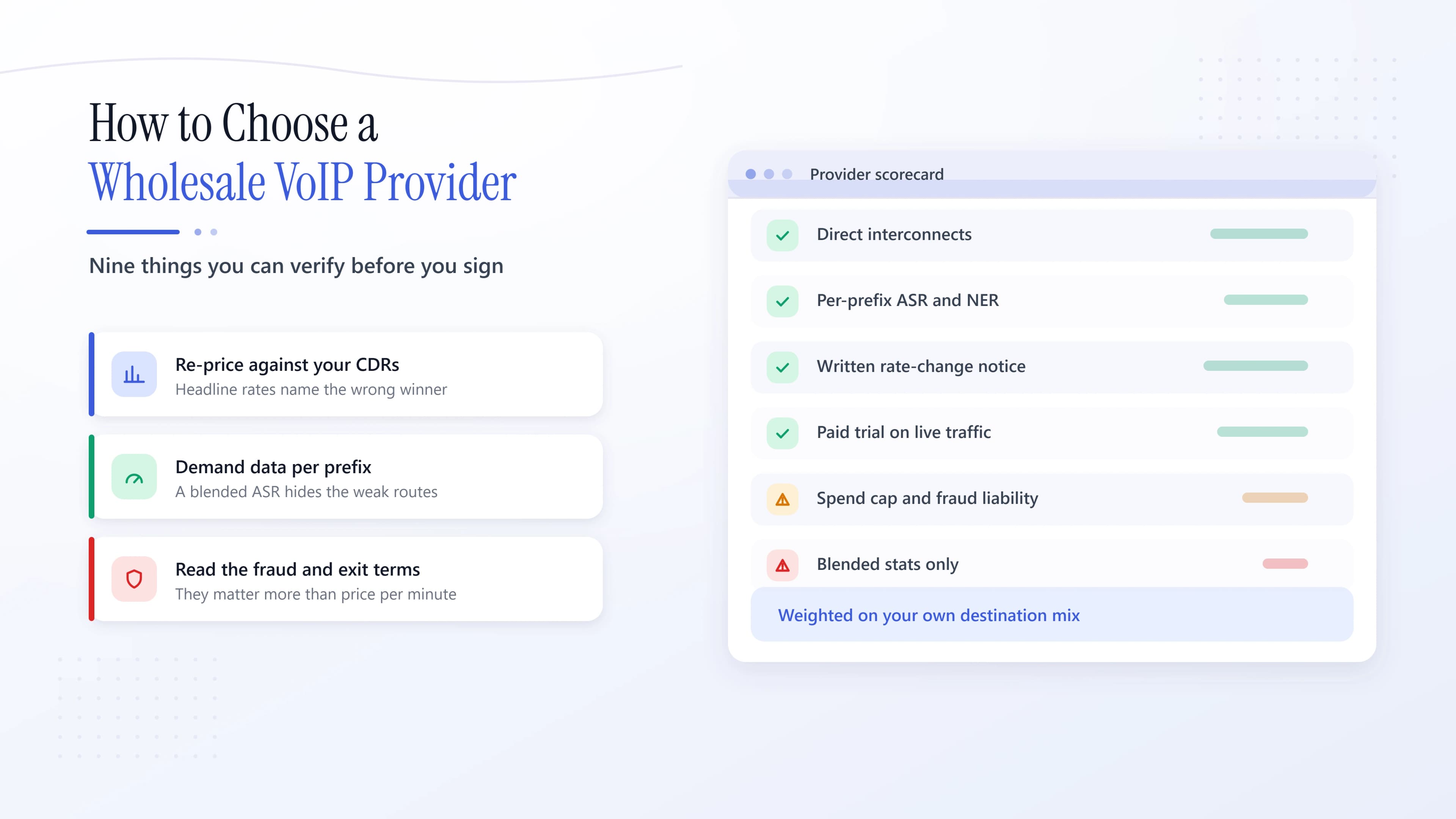
When you shop for wholesale voice services, price should be the last thing you compare, not the first. Work down this list and drop any provider that cannot answer. For the longer buyer version, see how to choose a wholesale VoIP provider.
- Coverage. Does it reach your destinations, at the quality you need?
- Route transparency. Will it say whether a route is direct or goes through another carrier?
- Per-destination quality data. ASR, ACD and PDD for your countries, not one headline figure.
- A test period. Can you try it before committing volume?
- Capacity and calls per second. How many channels, and how fast can it accept new calls?
- Billing and reporting. Real-time call records, readable invoices, and notice of rate changes.
- Compliance. Fraud controls and a clear lawful-use policy.
- Support. A network operations team or account manager who answers when a route degrades.
- Interconnect options. SIP, IP-to-IP, and TLS and SRTP for encryption.
Common Mistakes to Avoid
Teams buying wholesale voice services for the first time tend to repeat the same handful of errors.
- Choosing on rate alone. A cheap route with poor ASR costs you in retries and lost customers.
- Skipping the test. Send full volume on day one and you will find the route problems with real customers on the line.
- Ignoring the increment. As the example above shows, 60/60 on short calls can quietly add a large share to your bill.
- Depending on one route. With no failover, one degraded route takes a whole destination offline.
- Leaving fraud controls off. Traffic pumping and stolen credentials can run up a large bill fast, so set spend limits and destination controls from the start.
Where Acepeak Fits
Acepeak provides wholesale VoIP and wholesale voice services for resellers, platforms and contact centers, including wholesale DID numbers. If you plan to resell the capacity under your own name, see the VoIP reseller program, or talk to the team to request rates and a test.
Pick the three or four destinations that matter most to you, ask for rates and quality figures on those, and test before you move volume.
Questions, answered.
Retail voice is sold to the end user, per seat or per minute. Wholesale voice is sold in bulk to resellers, platforms and carriers at lower per-minute rates, and it gives you more say over which routes carry your calls.
It is the delivery of an outbound call from your network to the number being dialed, over the receiving carrier's network. You pay for it per minute.
There is no single answer, because both depend on the country and the kind of traffic. Compare providers on the same destinations and similar traffic, and look at how the numbers change over time.
Send a small, controlled volume to your key destinations and compare ASR, ACD, PDD and audio quality with your current provider before you move any real traffic.
Some providers allow it and terms vary. Ask about minimum spend, deposits and notice of rate changes before you sign.
// Tags
- Wholesale Voice
- Voice Termination
- Wholesale VoIP
- ASR and ACD
- Carrier Routes
- SIP Trunking