Born When Manhattan's 917 Numbers Ran Dry
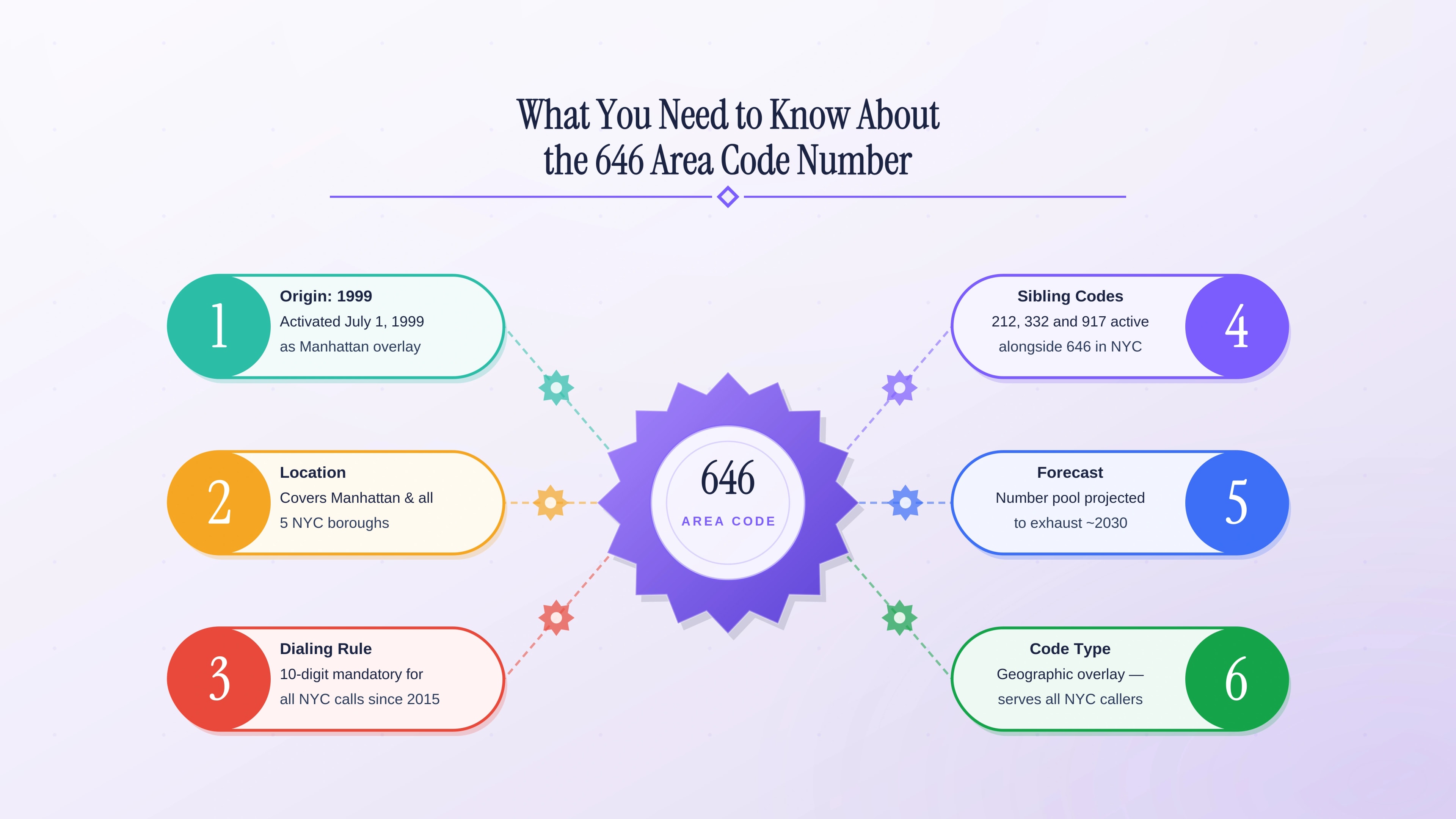
Area code 646 covers Manhattan in New York City, operating as a 10-digit overlay alongside codes 212, 332, and 917. A number with this prefix carries the cultural and commercial weight of Manhattan — instantly recognisable to clients, partners, and customers across the United States and beyond.
Manhattan's explosive growth in mobile subscriptions exhausted the 917 number supply in the late 1990s. To resolve the shortage without forcing existing subscribers to change their numbers, regulators activated 646 as a pure overlay on July 1, 1999. Because it shares geography with three other codes, all local calls within New York City require ten-digit dialling. With the prefix projected to reach number exhaustion around 2030, early acquisition of a preferred 646 number is increasingly strategic.
Key Takeaways
- The prefix covers Manhattan and operates as a mandatory 10-digit overlay code.
- It went live on July 1, 1999, to relieve pressure on the saturated 212 and 917 number pools.
- A Manhattan-prefix number signals credibility and local presence in one of the world's most influential cities.
- Number depletion is projected around 2030 — making early acquisition a smart move.
What You Need to Know About the 646 Area Code Number
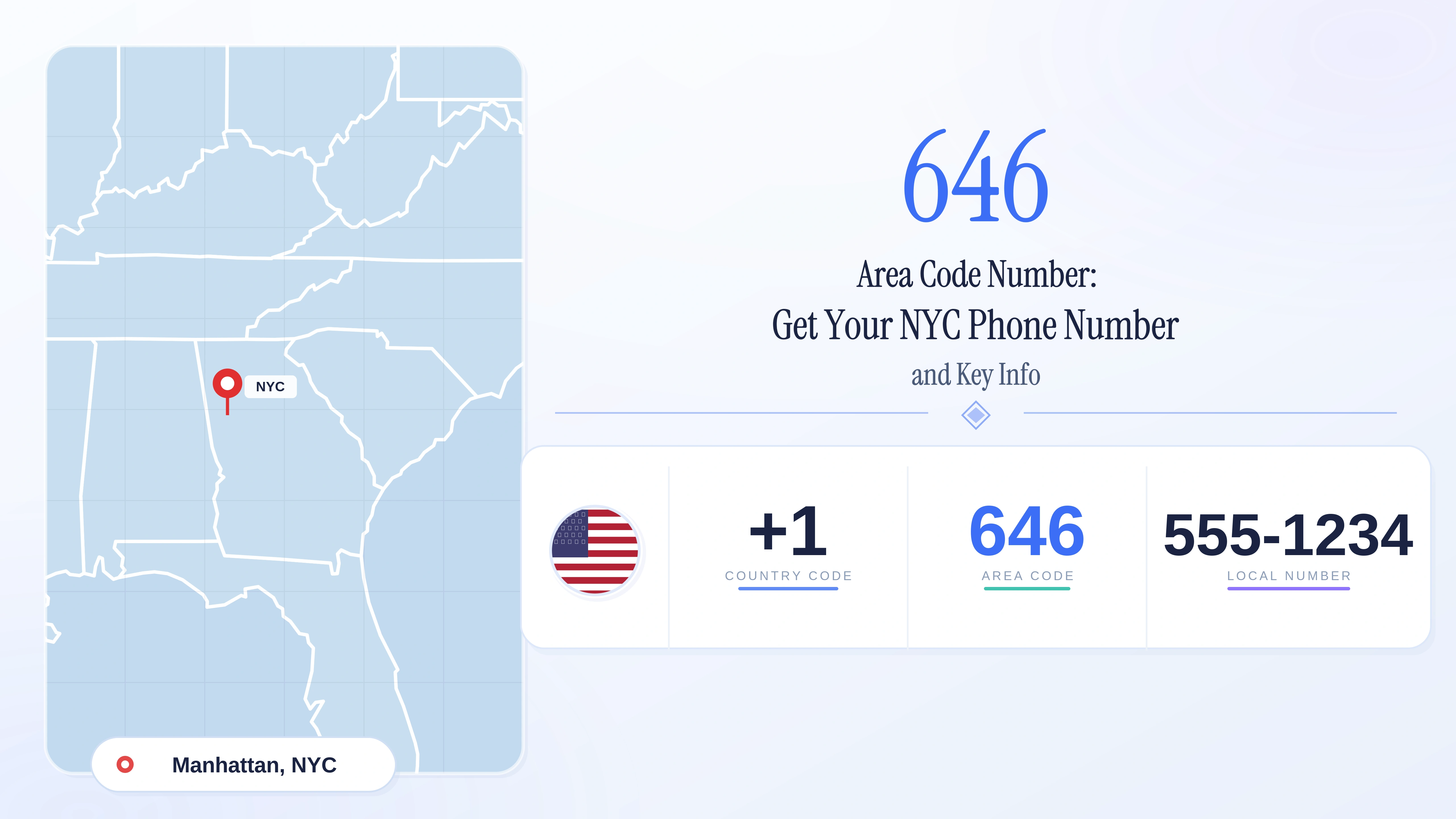
The 646 phone area code is a telephone area code serving Manhattan, New York City. Activated on July 1, 1999, it was introduced as an overlay to relieve the exhausted 917 mobile number supply while leaving existing 212 numbers intact. Because multiple codes share the same geography, ten-digit dialling is mandatory for every call made within the region.
The overlay model maximised number availability in one of the country's densest urban environments. Each new smartphone, VoIP line, and IoT device requires a unique number; by drawing from the 646 pool, New York's telecommunications network absorbed rapid subscriber growth without the disruption of a geographic split. A fourth overlay — area code 332 — was added in June 2017 when 212 numbers neared exhaustion.
Four Codes, One Island: How Manhattan Ended Up This Way
Manhattan is unusual even by big-city standards: four separate area codes ring the same streets. Untangling them explains why a 646 number behaves the way it does. 212 came first, assigned in 1947 as the original code for the entire city. In 1992 the whole of New York City was overlaid with 917 — a code originally earmarked for the Bronx and for mobile service, which is why so many older cell numbers still carry it. When Manhattan's mobile growth drained the 917 supply in the late 1990s, regulators activated 646 on July 1, 1999 as a pure overlay, adding capacity without forcing a single existing subscriber to change a number. Then in November 2015, with 212 long since closed to new assignments, 332 was authorised as a third Manhattan overlay — the fourth code serving the borough and the seventh serving New York City.
That history has one practical consequence worth internalising before you buy a line: because four codes share identical geography, the code itself no longer tells anyone which part of Manhattan you are in — it only tells them you are in Manhattan. There is no Midtown code and no Wall Street code. A 646 number in the Garment District and a 646 number in Inwood are indistinguishable to a caller. What the prefix still does communicate, reliably, is the borough — and in a city where the outer-borough 718 and the citywide 917 read very differently to a New York customer, that distinction is the whole point.
The 646 Area Code: Geographical Location and Coverage
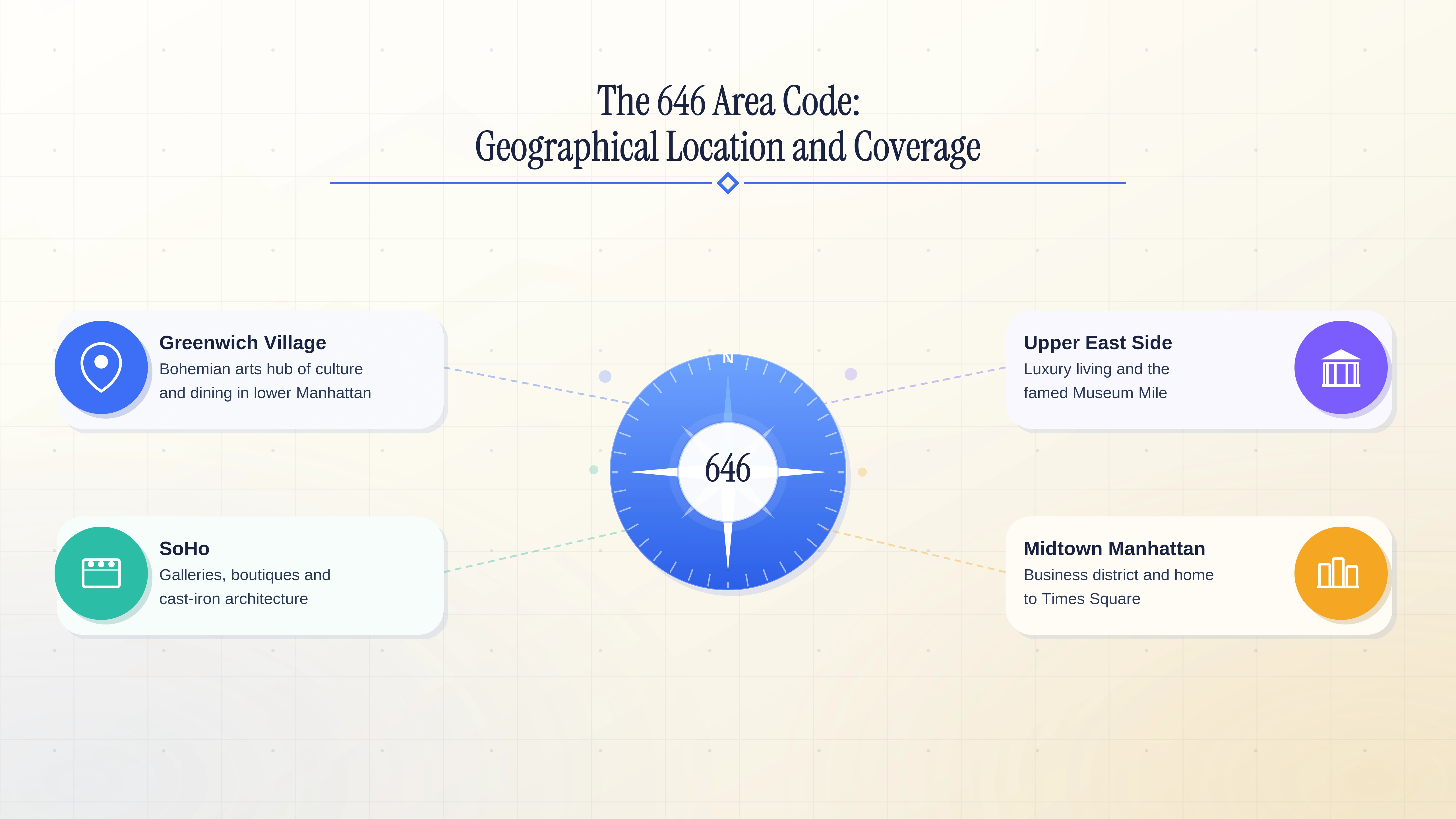
The area code 646 is exclusively associated with Manhattan, covering the island from the Financial District in the south to Inwood in the north. Area code 212 — the original New York code assigned in 1947 — covers identical geography, with 332 added as a third Manhattan overlay in June 2017. All four codes (212, 332, 646, and the citywide 917) operate within the Eastern Time Zone (UTC-5). One geographic exception is the Marble Hill neighbourhood: although administratively part of Manhattan, its telephone infrastructure is wired into a Bronx exchange, placing it under the 718/347/929 numbering area.
The 646 overlay encompasses Manhattan's full range of districts. Prominent areas include Greenwich Village, SoHo, the Upper East Side, Harlem, Midtown, and the Financial District. This breadth makes the prefix relevant for companies operating across virtually every industry vertical present in New York City.
Manhattan is home to roughly 1.6 million residents packed into just 23 square miles, making it one of the most densely populated urban centers in the United States — and one of the most concentrated business landscapes as well. A 646 number carries weight differently depending on where in that landscape a business sits: in the Financial District and around Wall Street, it signals proximity to the world's largest financial hub; in the Flatiron District and Chelsea's so-called Silicon Alley, it places a company inside New York's tech and startup corridor; and in the Garment District, it connects a brand to the city's century-old fashion and apparel trade. Because the 646 overlay reaches every one of these districts equally, the prefix works as a flexible, borough-wide credibility signal rather than a narrow neighborhood identifier.
How to Get an Area Code 646 Phone Number
Acquiring a 646 number is a straightforward, mostly online process whether the line is for a business or an individual.
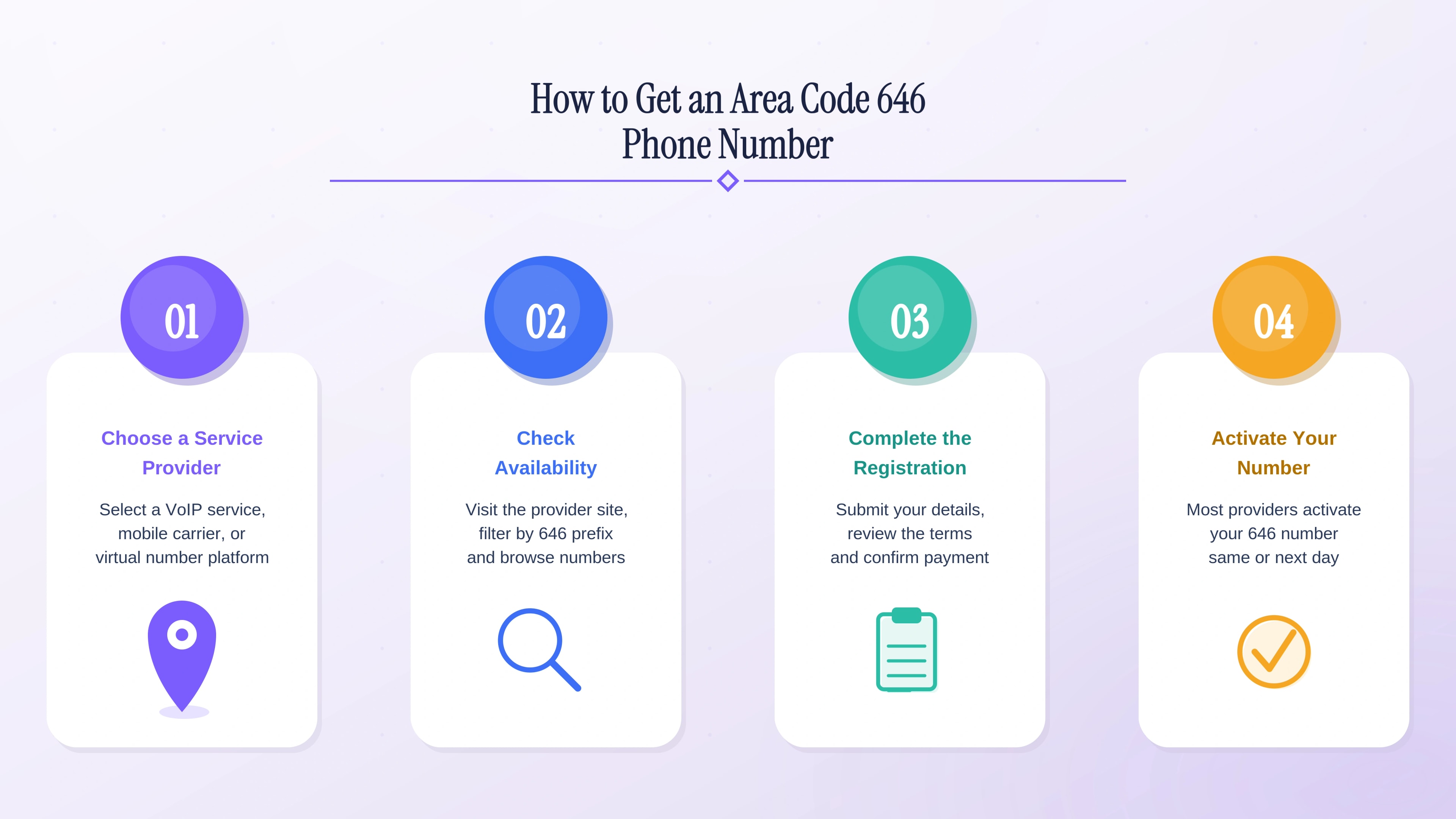
- Choose a service provider — options include traditional mobile carriers such as Verizon and T-Mobile, VoIP services like Acepeak, and dedicated virtual number platforms.
- Check availability — filter the provider's number search by the 646 prefix. Given the projected 2030 depletion timeline, preferred numbers should be reserved promptly.
- Select your number — choose a number aligned with the business or personal brand. Memorable patterns tend to be claimed quickly.
- Complete the registration — submit identification, address, and payment details. Review porting policies and contract terms carefully.
- Activate your number — most VoIP services offer same-day or next-day activation.
Options for Businesses and Individuals
- For businesses — virtual phone systems bundle multiple extensions, voicemail transcription, call forwarding, and CRM integrations under a single Manhattan number.
- For individuals — VoIP is especially practical for remote workers who want a New York identity while working from another location.
Cost Considerations
Monthly line fees, per-minute call rates, and add-ons such as caller ID rotation and analytics all vary by provider.
Claim a Manhattan 646 number today
Acepeak provisions local New York numbers with call routing, analytics, caller ID rotation, and same-day activation — no NYC office required.
646 Area Code vs. Other New York City Area Codes
Area code 212 is fully exhausted for new assignments — AT&T confirmed zero new 212 numbers in August 2010 — leaving 646 and 332 as the practical choices for new lines. With a track record dating to 1999, 646 enjoys significantly greater consumer recognition than the newer 332.
| Area Code | Coverage Area | Best For |
|---|---|---|
| 212 | Manhattan | Established businesses; prestige (no new assignments) |
| 332 | Manhattan | Newest overlay; limited consumer familiarity |
| 718 | Brooklyn, Queens, Bronx | Businesses targeting outer boroughs |
| 917 | All NYC boroughs | General use, mobile-first flexibility |
| 646 | Manhattan | Recognised Manhattan identity for new lines |
Dialing Format for 646 Phone Area Code Numbers
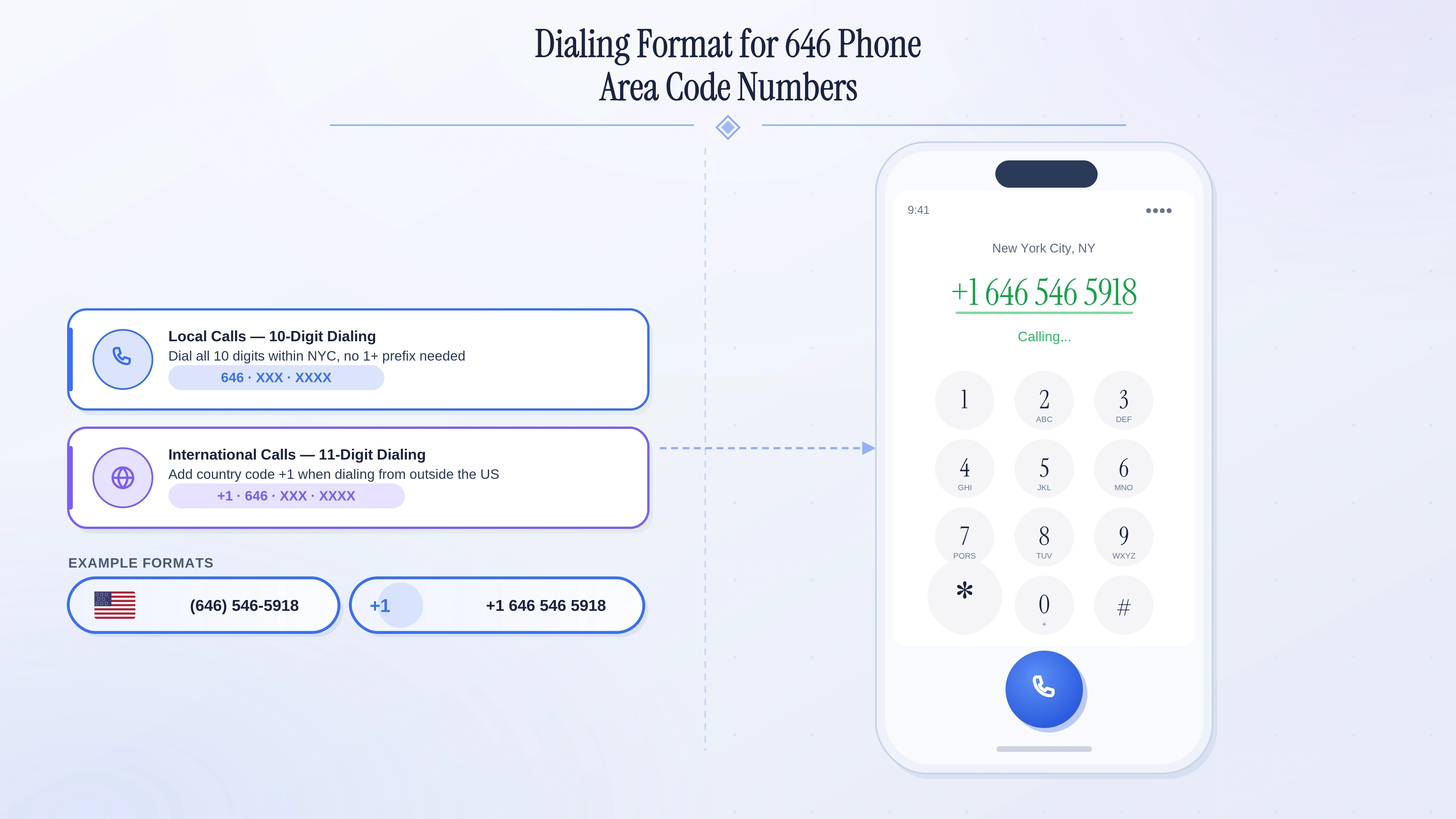
Because 646 is an overlay, ten-digit dialling is mandatory for every local call within New York City — there is no leading "1" for local calls.
| Call Type | Format | Example |
|---|---|---|
| Local (within NYC) | 10-digit number | 646-555-1234 |
| Long-distance (within the U.S.) | 1 + 646 + 7 digits | 1-646-555-1234 |
| International | Exit code + 1 + 646 + 7 digits | +1-646-555-1234 |
Local vs. Toll-Free: Why Choose a 646 Number Over a Toll-Free One?
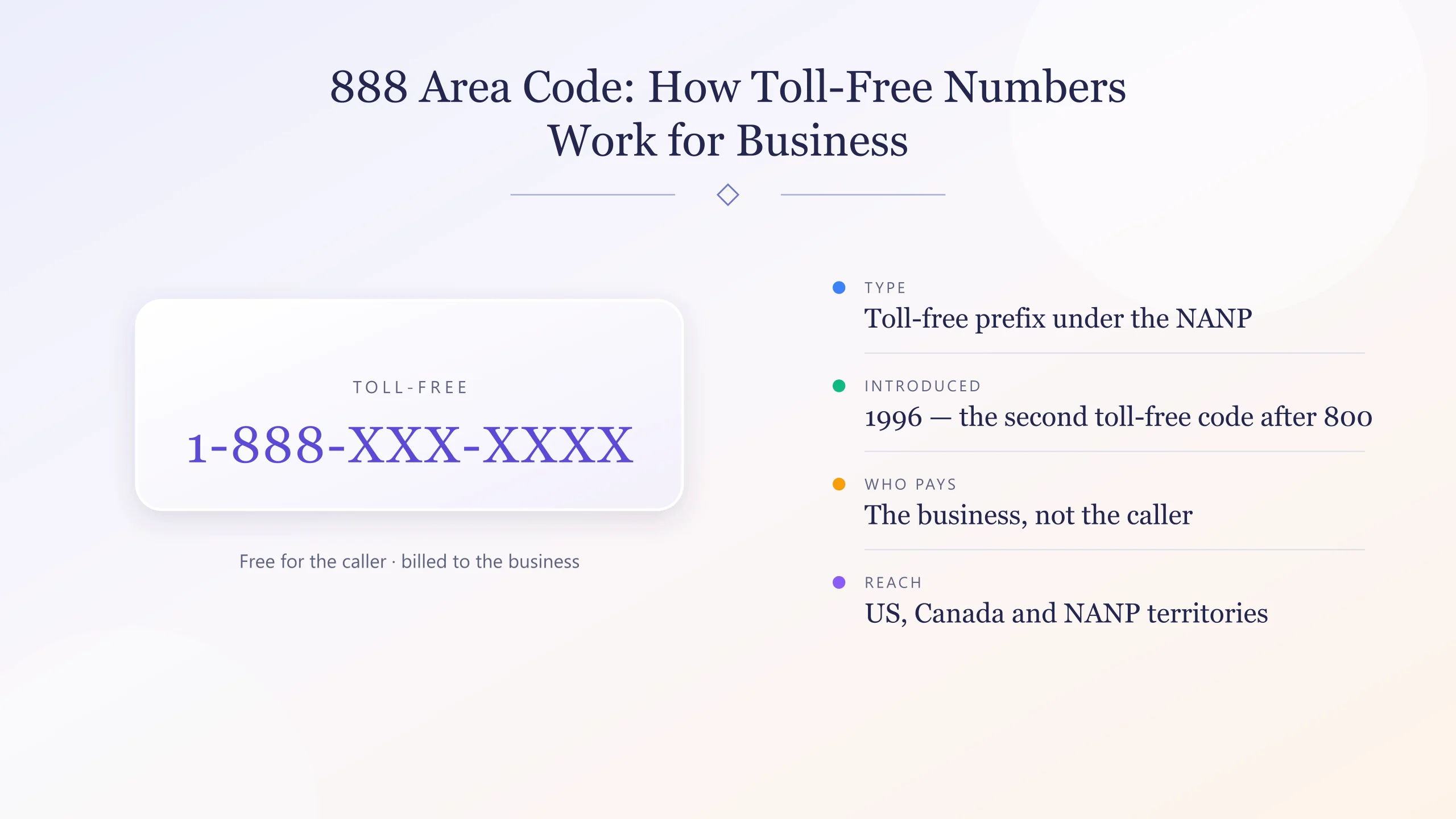
A local Manhattan prefix creates an immediate geographic connection. NYC consumers are more likely to answer calls from a recognisable neighbourhood code than from an 800/888 number. VoIP providers also typically offer local numbers at lower monthly rates than toll-free lines.
Scammers frequently spoof 646 numbers. Any unsolicited call requesting personal information should be verified through official channels before any action is taken.
Should You Hold Out for a 212 Number Instead?
This is the question most Manhattan buyers actually arrive with, and it deserves a straight answer: you cannot simply buy a 212. The code has been closed to new assignments since 2010, so the only 212 numbers in circulation are ones already held by someone else. A secondary market does exist — brokers resell retired 212 lines, sometimes for four figures — and businesses that trade heavily on legacy prestige occasionally decide that is worth paying for.
For nearly everyone else it is not. A 212 signals that a business has existed for a long time, which is a genuine signal only if the business actually has. On a two-year-old company it reads as bought, because it was. 646 has been ringing in Manhattan since 1999 — long enough that New Yorkers file it mentally alongside 212 rather than treating it as new — and it can be provisioned today at standard rates with no broker in the middle. The practical choice is between 646 and 332, and there 646 wins on familiarity: it has a twenty-six-year track record where 332 arrived in 2015 and still reads as unfamiliar to many callers.
What Happens When 646 Runs Out
NANPA projections put 646 at exhaustion around 2030. In practice that milestone matters far less than it sounds. Exhaustion means no new 646 numbers get issued; it does not mean existing ones stop working, and number portability rules protect every line already in service. What actually happens is what happened in 2015: regulators authorise another overlay, and new Manhattan lines start drawing from that pool instead.
The one real consequence is selection. As a code approaches exhaustion the remaining inventory thins, and the memorable patterns — repeated digits, sequential runs, numbers that spell something — go first. If a specific, easy-to-say number matters to how your business is found and remembered, that is the argument for claiming one sooner rather than later. If any working Manhattan number will do, the 2030 date should not drive your timing at all.
Manhattan Recognition Until Exhaustion Around 2030
The 646 prefix is a cornerstone of Manhattan's telecommunications framework, live since 1999 and projected to serve the borough until approximately 2030. It delivers local recognition, flexible acquisition through VoIP and virtual number platforms, and the practicality of 10-digit overlay dialling.
Questions, answered.
The 646 phone area code serves Manhattan in New York City. Activated on July 1, 1999, it operates alongside 212 and 332 under mandatory 10-digit dialling rules, and is expected to reach number depletion around 2030.
No — they're different area codes that happen to serve the exact same geography. 212 is Manhattan's original code, assigned in 1947 and now fully exhausted for new numbers; 646 was added in 1999 as an overlay to relieve that shortage, followed by 332 in 2017. All three ring within Manhattan and are dialed the same way, so a 646 number is just as authentically "Manhattan" as a 212 one — it's simply newer.
Through mobile carriers such as Verizon or T-Mobile, or VoIP providers such as Acepeak. Select a number, complete registration, and activate the line.
Yes. Number portability rules allow users to retain a 646 number even after relocating.
You get competitive pricing, responsive support, and advanced features such as voicemail detection, caller ID rotation, and real-time call analytics.
Local NYC: dial all 10 digits. US long-distance: add a leading "1". International: exit code + +1 + area code + number.
Yes. Scammers use spoofing to display 646 prefixes. Verify unexpected callers through official contact details before responding.
Signing up for a 646 area code number takes minutes with a cloud phone provider — no local office in New York City required. Pick the number, connect it to your existing phone or app, and calls route in immediately. This keeps the 646 area code presence you already have while adding the local credibility New York customers respond to.