A Toll-Free Prefix With No Home State
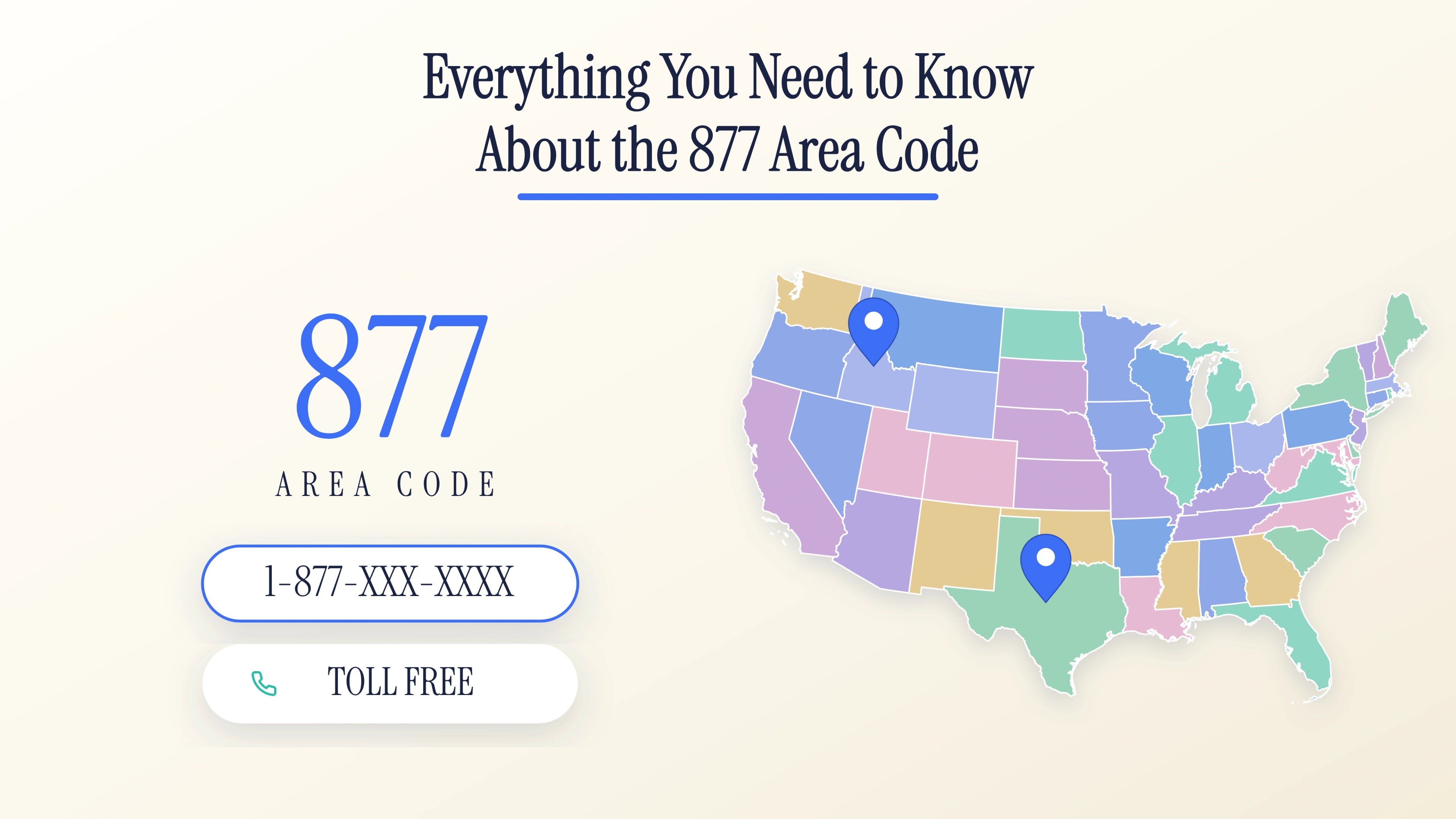
The 877 area code is one of the best-known toll-free prefixes in North America. A normal area code ties to one state or city. The 877 prefix does not. It works across the whole United States, Canada, and the Caribbean under the North American Numbering Plan (NANP). Businesses of every size use 877 numbers to look professional and nationwide, while callers never pay a cent to reach them. Knowing how this prefix works, what it offers, and how to get one helps a business make smarter calling decisions.
Key Takeaways
- Free for callers — the 877 area code is a toll-free prefix. Callers pay nothing to connect; the business absorbs the cost.
- Activated in 1998 by the FCC as part of the 800-series toll-free expansion under NANP.
- Wide coverage — spans the US, Canada, and the Caribbean with no geographic limits.
- Business upside — better customer satisfaction, clear call analytics, and nationwide reach.
- Pick carefully — compare providers on price, call quality, features, support, and scalability.
What Is a Toll-Free Prefix?
The 877 area code is a toll-free prefix under the North American Numbering Plan. NANP sets the rules for phone numbering across the United States, Canada, and many Caribbean nations. The FCC turned on 877 in 1998. It came as part of the 800-series toll-free rollout — a group of prefixes that includes 800, 833, 844, 855, 866, 877, and 888 — built to meet rising demand for free-to-caller business lines.
The key trait of a toll-free number: the business being called pays for the call, not the caller. This removes a real barrier to customer contact. It matters most for businesses with customers spread across the country or beyond.
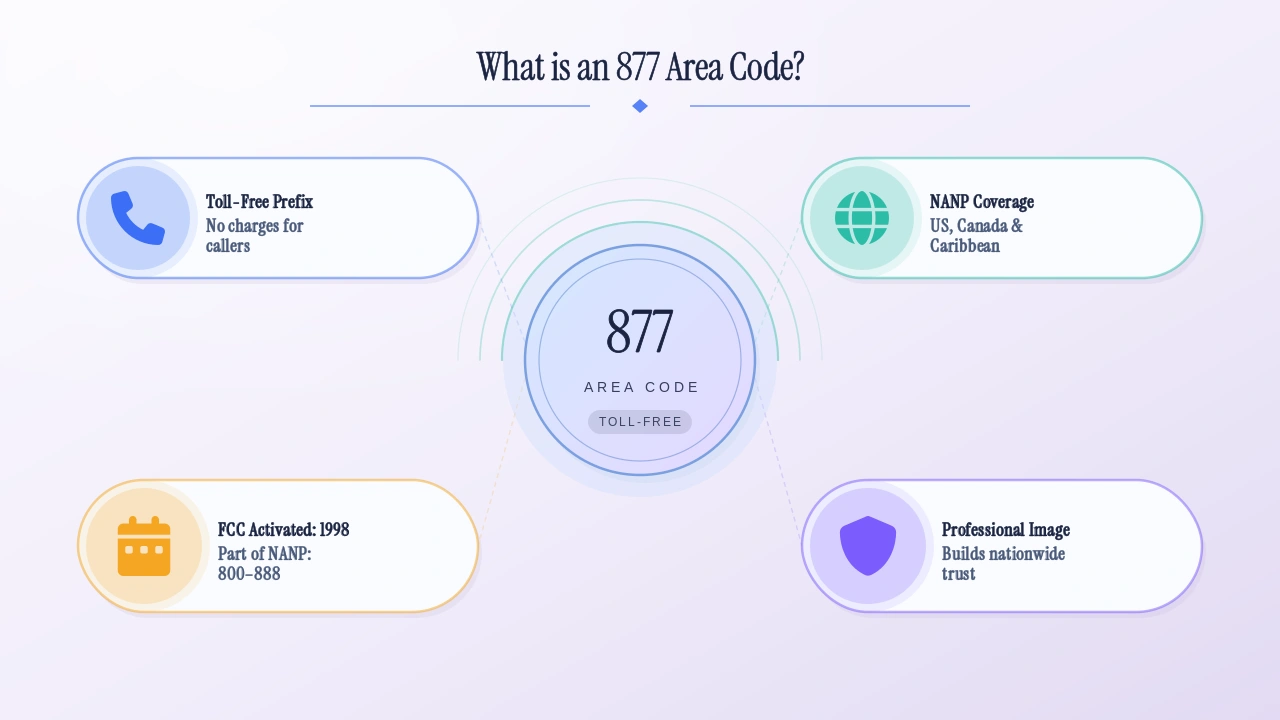
- Toll-free prefix — no charges pass to callers, no matter where they call from within the NANP footprint.
- NANP coverage — numbers work from the US, Canada, and the Caribbean under one dialing system.
- FCC activated: 1998 — part of the wider 800-series family, built to ease number shortages in the original 800 pool.
- Professional image — a toll-free number signals nationwide credibility and builds trust before a word is spoken.
How Do Toll-Free Numbers Work?
When a caller dials an 877 number, the call moves through four steps run by the carrier network and the business's chosen provider.
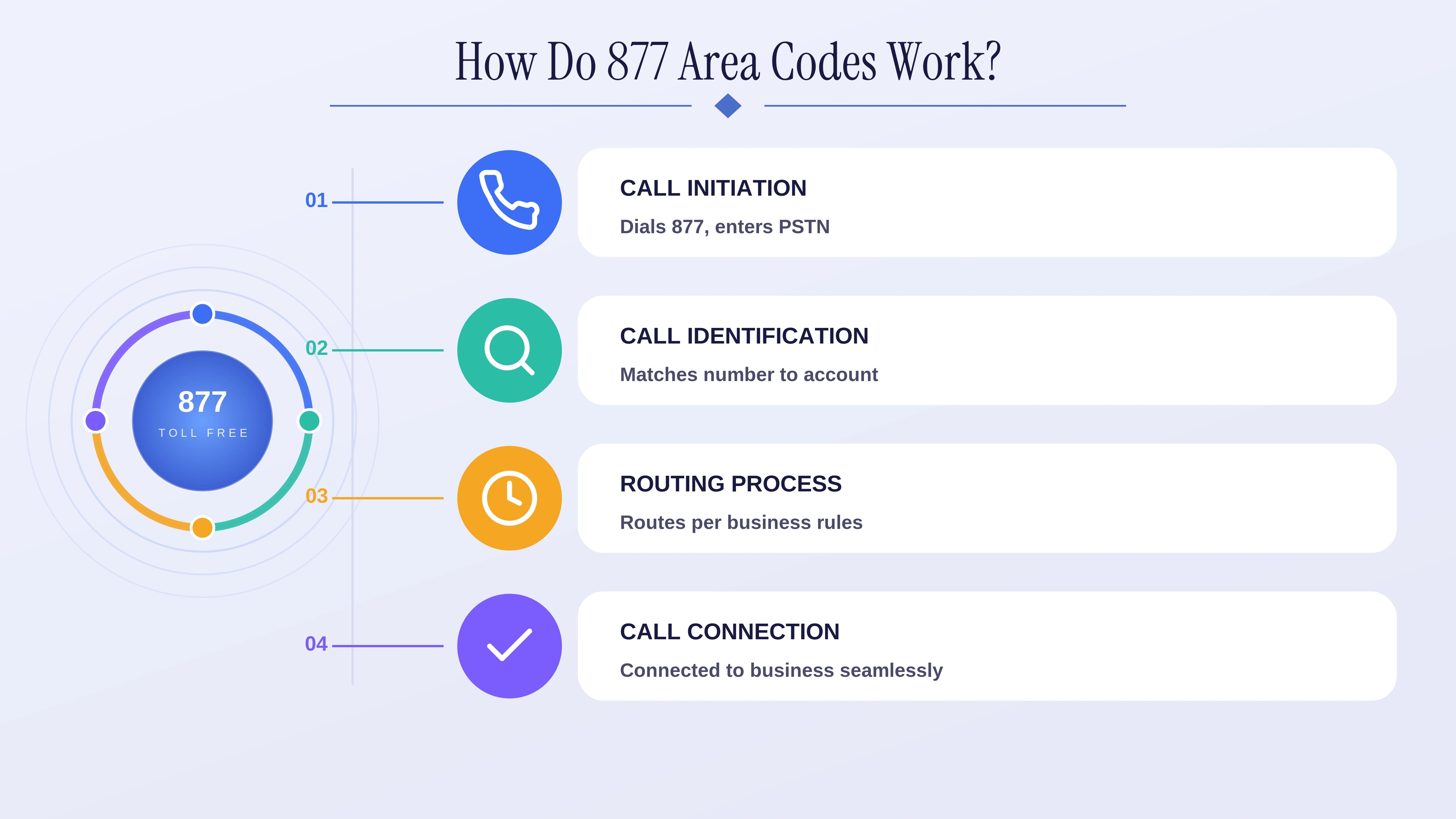
- Call initiation — the customer dials the 877 number. The call enters the Public Switched Telephone Network (PSTN), where it is flagged as a toll-free request for special routing.
- Call identification — the carrier checks a toll-free database to match the dialed number to the business's account. This lookup finds which provider manages the number and pulls up its routing setup.
- Routing process — based on the business's own rules, the network sends the call to the right place — a call center, a branch office, a remote agent, or any other endpoint. Routing can follow the time of day, the caller's location, or the agent's skills, depending on the provider.
- Call connection — the routed call reaches the business, and the conversation begins. From the caller's side, it feels just like any other call — the toll-free system stays invisible in the background.
This whole process usually takes under two seconds. Callers get an experience just like a normal local call, while businesses keep tight control over how and where calls land.
Key Benefits of a Toll-Free Number
An 877 number brings four clear gains for businesses.
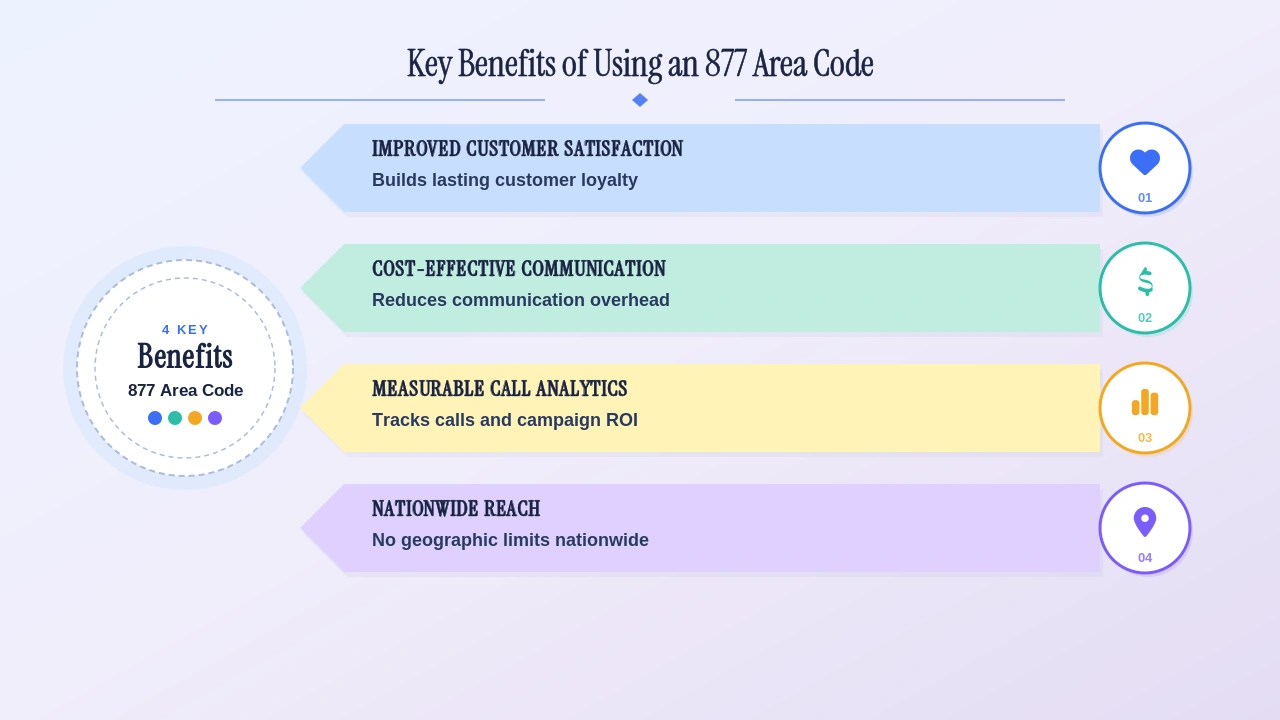
Improved Customer Satisfaction
Free calls remove a friction point that stops potential customers from reaching out. Studies show people call a business far more often when they know the call costs nothing. This easy access builds lasting customer loyalty and stronger long-term relationships.
Cost-Effective Communication
The business still pays per-minute rates for inbound toll-free calls. But routing all inbound traffic through one 877 number cuts the hassle of managing separate local numbers across different regions. One central number lowers costs as the business grows.
Measurable Call Analytics
Toll-free providers attach solid analytics to 877 numbers — tracking call volume, call length, where calls come from, busy times, and which campaign drove each call. These numbers let businesses measure the return on marketing spend, plan staffing better, and make smarter calls about their communication strategy.
Nationwide Reach
An 877 number has no geographic limits. A business based in any city can offer one easy-to-remember toll-free number to customers from coast to coast, into Canada, and across the Caribbean — no need to juggle a patchwork of local numbers. Unlike the near-exhausted 800 area code pool, 877 numbers still have strong availability, including memorable vanity sequences.
Ready to Get Your 877 Number?
Establish a professional, nationwide presence today with Acepeak's cloud-based business calling platform.
How to Get a Toll-Free Number
Getting an 877 number takes just four simple steps.
Step 1 — Choose a Provider
Pick a trusted toll-free provider with a reliable network, clear pricing, and the features the business needs. Check providers against the five criteria in the next section before you commit.
Step 2 — Pick Your Number
Browse the provider's list of available 877 numbers. Many providers offer search tools that let businesses filter by number pattern, making it easier to find a memorable sequence or a number that spells a word tied to the brand — a vanity number.
Step 3 — Set Up Routing
Set up call forwarding rules to send inbound calls to the right place. This can include time-of-day routing, location-based routing, overflow rules, voicemail setup, and AI receptionist integration. Most modern providers offer self-service dashboards that make this easy.
Step 4 — Go Live
Turn on the number and start taking calls. Test the full call flow before you put the number in marketing materials, to confirm routing, voicemail, and any IVR menus work as planned. The whole process — from sign-up to a live 877 number — can wrap up in under 24 hours with most cloud-based providers.
Comparing 877 Area Code Providers
Not all toll-free providers offer the same experience. Providers must be certified as Responsible Organizations (RespOrgs) under the North American Numbering Plan to legally manage number assignments. Checking providers against five criteria helps the business pick a solution that fits its needs.
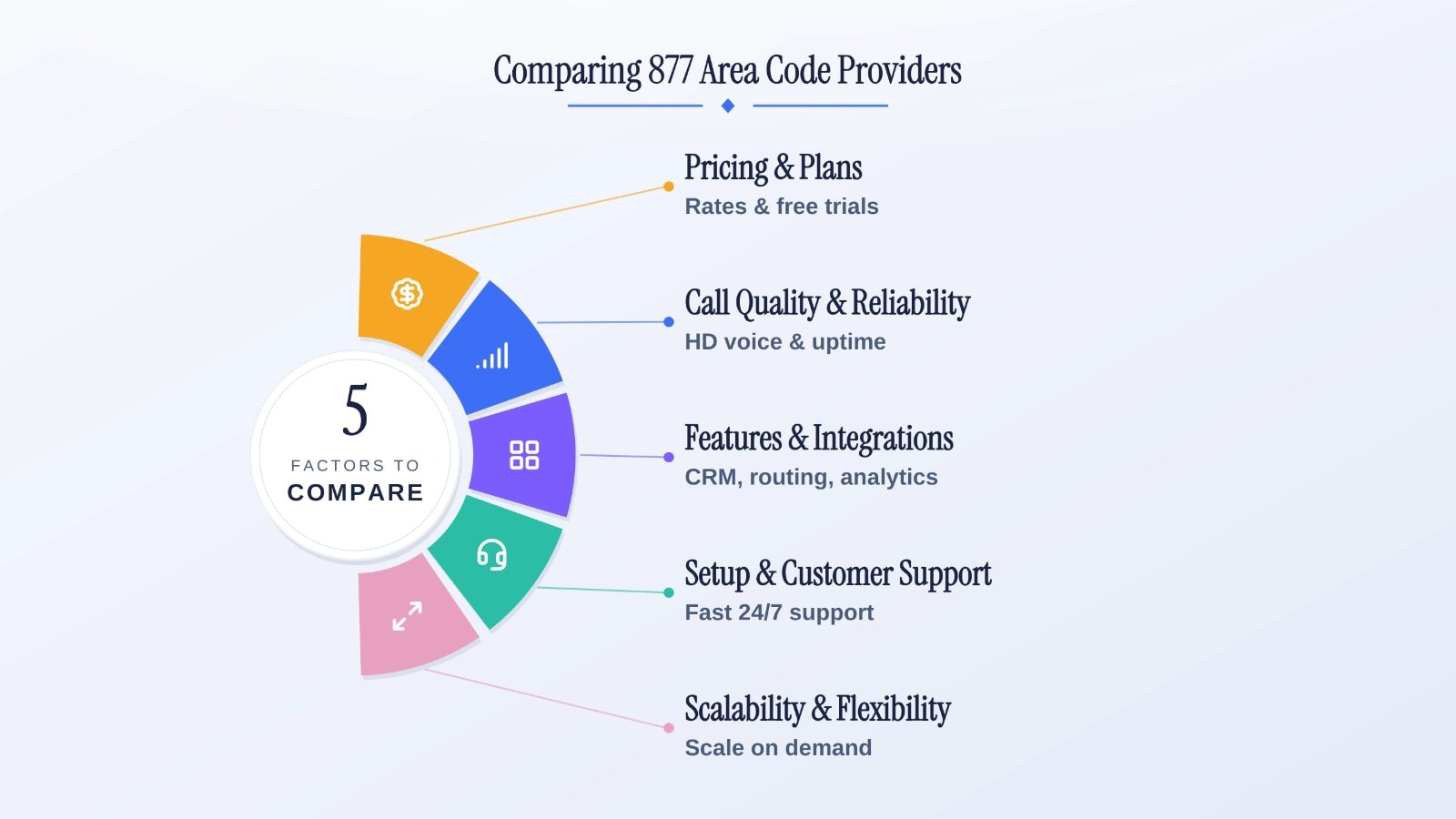
| Criterion | What to Look For | Why It Matters |
|---|---|---|
| Pricing & Plans | Monthly base cost, per-minute inbound rates, free trials, setup fees | Avoids hidden costs and long-term lock-in |
| Call Quality & Reliability | HD voice, 99.99% uptime SLA, carrier redundancy | Missed calls on a toll-free line mean missed revenue |
| Features & Integrations | CRM sync, IVR, call recording, real-time analytics | Connects 877 calls to existing workflows without friction |
| Setup & Customer Support | 24/7 support, fast onboarding, self-help resources | Critical for businesses that cannot afford extended downtime |
| Scalability & Flexibility | Multi-location support, on-demand provisioning, API access | Prevents capacity bottlenecks as the business grows |
Who Actually Owns an 877 Number
Toll-free numbers work differently from geographic ones in a way that matters commercially, and most guides skip it. A 770 or 646 number belongs to a carrier's block for a specific place. An 877 number belongs to nowhere — it lives in a national registry called Somos, and the entity that controls it is not your phone company but a RespOrg, or Responsible Organization, operating under FCC rules. Your provider is usually acting as, or through, a RespOrg on your behalf.
The practical consequence is portability. Because the number is held in the registry rather than owned by the carrier, moving providers means reassigning the RespOrg record — the number itself does not change. A business that has printed an 877 number on vehicles, packaging and signage for a decade can switch telephony vendors without reprinting anything. That is a genuinely different position from a geographic number, where portability exists but is bounded by the rate centre the number came from.
It is also worth knowing that 877 was not the first toll-free code and will not be the last. AT&T launched 800 in 1967; when it filled, 888 followed in 1996, then 877 on April 4, 1998, 866 in 2000, 855 in 2010, 844 in 2013 and 833 in 2017. They are functionally identical — none is more legitimate than another — though 800 retains the strongest recognition simply from age. One modern detail that often goes unnoticed: toll-free numbers can be text-enabled, so the same 877 line that answers a support call can also receive SMS, which for many businesses removes the need for a separate messaging number entirely.
A Portable National Line Callers Never Pay For
The 877 area code is a strong tool for any business that wants to look professional, remove barriers to customer contact, and get real insight into its inbound calls. Activated in 1998 as part of the NANP's toll-free expansion, it gives businesses nationwide reach with no geographic limits. By comparing providers carefully on pricing, quality, features, support, and scalability, businesses can land on an 877 number that pays off long term. Platforms like Acepeak make it easy to get started with a cloud-based toll-free solution that grows with the business.
Build Your Nationwide Presence Today
Connect customers across the US, Canada, and the Caribbean with an 877 toll-free number from Acepeak.
Questions, answered.
An 877 area code number is a toll-free phone number under the North American Numbering Plan. Callers pay nothing to dial it; the business that receives the call covers the cost.
The FCC activated the 877 prefix in 1998, as part of the expansion of the 800-series toll-free number family, which also includes 800, 833, 844, 855, 866, and 888.
An 877 number can be reached from anywhere within the NANP footprint — the United States, Canada, and many Caribbean nations. Calls from outside this footprint may need international dialing and could bring standard international rates for the caller.
Costs vary by provider. Most charge a monthly base fee plus per-minute inbound rates, usually between $0.02 and $0.06, with extra toll-free numbers often running $2 to $10 per month.
Both are toll-free prefixes under the NANP, and callers pay nothing to dial either one. They work the same way for the caller, though 800 numbers have a longer history and sometimes feel more established.
Not quite — 877 is one of the toll-free codes (alongside 800, 833, 844, 855, 877, and 888) rather than a geographic area code. An 877 number works nationwide and the caller isn't charged for the call, which is why businesses use it for support and sales lines that reach customers anywhere in the country.